Denisovan Ancestry in East Eurasian and Native American Populations

Showing posts with label limestone. Show all posts

06 October 2011

"Sir Nameless"

 "Sir Nameless" pictured with his shadow.
Silhouette sculpture on stone plaque shows faces on both sides
Licking County, Ohio, find by Ken Johnston and Lyn Niday

This facial profile sculpture is from a newly disturbed soil context from construction activities at a tree park about 5km from Buckeye Lake in southern Licking County, Ohio. The context was sterile of glacial deposits and had only native Ohio bedrock-type limestone and sandstone objects and naturefacts.  The immediate context (3m radius) also produced a couple of crude tools, coarse stone lithic debris and two other suspected art pieces (a bird and a feline) which will be the subjects of future postings on this blog.  "Sir Nameless"- Beautiful, narrow, facial profile sculpture shows faces on both sides, named after the 

Thomas Hardy poem, "The Children and Sir Nameless"

Sir Nameless, once of Athelhall, declared:
"These wretched children romping in my park
Trample the herbage till the soil is bared,
And yap and yell from early morn till dark!
Go keep them harnessed to their set routines:
Thank God I've none to hasten my decay;
For green remembrance there are better means
Than offspring, who but wish their sires away."

Sir Nameless of that mansion said anon:
"To be perpetuate for my mightiness
Sculpture must image me when I am gone."
- He forthwith summoned carvers there express
To shape a figure stretching seven-odd feet
(For he was tall) in alabaster stone,
With shield, and crest, and casque, and word complete:
When done a statelier work was never known.

Three hundred years hied; Church-restorers came,
And, no one of his lineage being traced,
They thought an effigy so large in frame
Best fitted for the floor. There it was placed,
Under the seats for schoolchildren. And they
Kicked out his name, and hobnailed off his nose;
And, as they yawn through sermon-time, they say,
"Who was this old stone man beneath our toes?"

-THE END-


"Sir Nameless" under camera flash illumination

Perhaps statistical mathematical analysis can be brought to bear on the subject of art candidate rocks such as this one.  There are approximately 12 edge lines comprising the profile of the face along the left side of the stone as pictured above.  Each of the edges is in proportionally correct size, shape, grading and angular alignment to compose a human face.  It seems statistically unlikely mother nature could do all the work to make a 12 point face at this level of exquisite detail.  One bad angle, one disproportionately sized edge, would impact the dramatic realism of this high art piece.  A second bad characteristic would have exponential degradation of the visual processing of the image as a "face."  It reminds me of something I read once:  how many bites out of a cutlet does it take before it is no longer a cutlet?  Only a human can sculpt an object like this.  The art and tool context of the find makes artificiality quite certain here.
  
With scale

Side 2 with scale

Thickness of stone plaque seen here


04 September 2011

Hexagon Rock

Hexagon Rock
Ansted, West Virginia, find by Ken Johnston
(click photo to expand)

This six-sided platter was found among suspected crude stone tools and two possible bird head sculptures in a 30 meter surface sample of the Shady Creek bed at Ansted, West Virginia.  The bird heads have been the subject of two recent postings on this blog.  I searched the internet for images of hexagon shaped rocks and could not find any other than the kind of hexagon basalt formations from well-known Giants Causeway in Ireland and other sites.  I then began to ponder the statistical probabilities of a natural rock having six sides of relative proportional equity.  Not being a statistician, I thought I'd post it here for others to consider and comment on.  


A similar looking, hexagon-shaped, stone from the Gault, Texas, site has a grooved double pattern which clearly identifies it as an artifact.  The West Virginia hexagon rock has no such visible etchings but was found in a cut from a geologically recent creek bed and may be water worn.  The Gault artifact appears to have had a break on the right side as pictured here and, if so, plausibly could have had a more equitable hexagon shape prior to the break.  The lower right corner hints at an angle of the former edge of a more proportionally shaped hexagon rock.

The Gault site engraved plaque could have been a more proportionally uniform hexagon shape at one time and then broken as the red line drawn on the West Virginia hexagon rock illustrates.  A foot-long ruler is pictured across the rock.
For those people familiar with geometry and aesthetics, perhaps there is something to this piece.  Having found no images of hexagonal rocks on the web and finding this in a possible tool and art context, make it a candidate for possible artifactuality, perhaps a functional platter like object, but maybe intentionally made with six sides for the novelty or some culturally mediated or aesthetic purpose.  I note the outline as seen in the diagram below somewhat resembles the profile, in an angular, stylized way, of a right side of a mammoth or mastodon which is sometimes represented by its simplest features in paleoart.


Mammuthus columbi, Columbian mammoth palentologist's photo reconstruction with white markups made by me to highlight major visual lines of the extinct animal and how they form a hexagon in rough proportion to the Ansted, West Virginia rock and possibly the Gault, Texas, engraved art piece.

24 August 2011

Bird head shaped limestone plaque considered in context supports possibility it was shaped in prehistory

Limestone plaque with possible bird head profile, from near Hawks Nest state park, Ansted, West Virginia, near the confluence of the Gauley and the New rivers. The park is named for the large numbers of birds of prey which nest in the old stone cliffs in the rich riparian environment.
  
Artifactuality is not evident on the tablet itself but its context, find location and possible imagery make it a candidate for recognition by someone in prehistory resulting in it being among crude tool lithics on the valley floor.  The discovery of two bird heads in a small survey area make it possible some more could found in the immediate locale with a closer look, and this could reinforce the liklihood of artifactuality here.

Right profile bird head silhouette image

A human shaped stone from the survey site, 30 meters along a West Virginia creek bed

side 2 of human shaped stone exposed by Shade Creek
A suspected duck head figure stone found in the same 30 meter surface survey of Shade Creek in Kanawah County, WV.  Even though the subject of this posting does not have any plainly evident signs of human agency, having found it in a cluster with this duck head and tools, make it possible it was worked into form or perhaps at least recognized as being bird like and manuported to a cultural site.  The duck rock was the subject of an earlier posting found here:


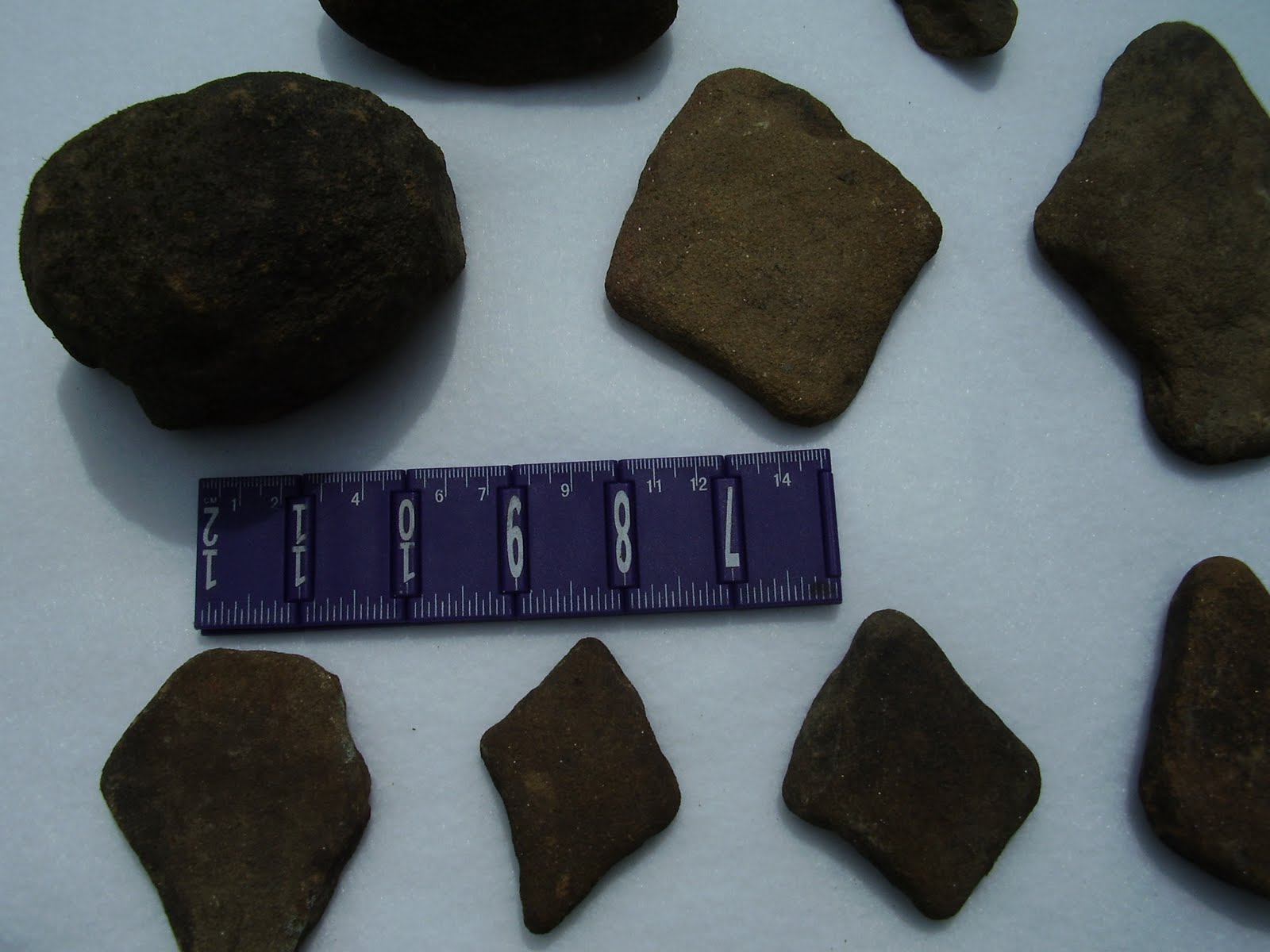
An unnatural number and proportion of triangular or rhomboid shaped flat stones, enough to demonstrate a pattern of human agency to me, were found in a sampling of the current bed of Shady Creek, Ansted, West Virginia.  The creek bed cuts 1 to 2 meters into the valley floor, exposing suspected crude tools and a couple of bird figure art artifacts.

click photos to expand

My interest in crude and opportunistic stone tools led me to observe patterns of human agency on non-tool artifacts and artifacts which resembled simple images of people and animals.  This led to my study of portable rock art.  In West Virginia, I was able to find an abundance of worked stone material and two possible bird head sculptures from a random stream-cut valley floor location in the hollow.  Thanks to Bill Niday family for allowing me access to their land.


The rhomboids were often made on tabular stone blanks using buffer technique according to James Harrod, Ph. D., at the web site originsnet.org.  These tools may indicate the presence of Homo erectus or other early humans in America.  These articles are generally dismissed as "geofacts" by archaeologists.
http://originsnet.org/cccgallery/index.htm


The near 90 degree angle in the lower right corner of the plaque, almost as if the bird head is truncated by the corner of a "frame," makes it possible for the object to rest on a horizontal surface in a correct viewing orientation.  The head could have been inserted into a slit or gap on a log or wooden staff for display or as a wooden bird body the stone head was attached to. (click photos to expand)