Denisovan Ancestry in East Eurasian and Native American Populations

Showing posts with label OH. Show all posts

08 October 2011

Rocks' pits may be art "cupules" on Columbian mammoth sculpture forms

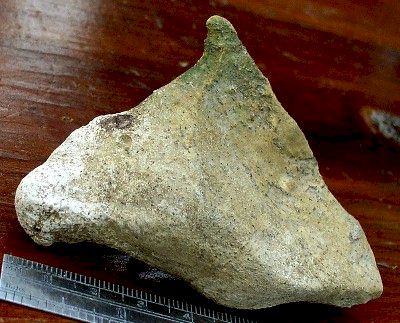
Pitted artifact found by Ken Johnston in Perry County, Ohio
This artifact may include imagery of the Columbian mammoth, species identifiable by the "bump" depicted at the top of the head.

 Columbian mammoth reconstruction

Buckeye Lake mammoth cupule stone #1 (of 2) was found in the disturbed soil of new subdivision road construction activities, on the south shore of Buckeye Lake, Perry County, Ohio.  Cupules, often identified by mid-west American archaeologists and collectors as "nutting stones," or "paint cups," or "grinding hollows," often appear to have had very limited or no evidence of use as tools.  The Buckeye Lake, Ohio, examples have discernible peck marks lining the cups, seemingly untouched by human action since the time they were created.  The 3 cups on the 2 stones seem to have been created under a preconceived idealistic form within definable size and shape parameters. This raises the possibility they are in fact symbolic cupules and were never used to crack nuts open.

Visual arts Cork (Ireland) web page on prehistoric cupules


To date, only a few proboscidian images have been documented in North America.  Examples are the Old Vero Beach Mammoth/mastodon (Purdy at. al. 2010), the Utah petroglyph recently described by Malotki and Wallace (2011), and Juan Armenta's 1959 find in Mexico.  Please see Pleistocene Coalition News, several issues, link is on right screen panel for free newsletter.  These images are all similar in that they are glyphic representations by use of incisions or organized pecking ("A line is a dot that went for a walk" -Paul Klee) made on stone or bone.  They are essentially "line drawings" of proboscideans.  Archaeological investigators would do well to consider the possibility of such imagery expressed in portable rock sculpture form, often "almost invisible" (A. Day), subtle to our visual-media-saturated brains, invoking only the most essential visual elements to allow one to "assemble a picture," often incorporating natural stone forms, which can signal recognition and signification of these awsome animals by America's earliest human inhabitants.  All art requires some level of participation on the part of the receiver.  My opinion is archaeologists need to participate a little more in order to begin to understand what art so far removed in time from us is all about.  As Ohio figure stone investigator Alan Day of the Day's Knob site has taught, "Know what you see, don't just see what you know." 

This is the reverse side of cupule stone #1.  It has a second cupule, exactly opposing the cupule on the other side, so the cupules almost touch at the center of the stone.  Human agency on this rock is not an issue and gauging the probability of intent to create mammoth imagery was given support by the recent find of a second cupule stone (photos below), which has significant agricultural plow damage.  It has the overall mammoth silhouette shape, remnants of diagnostic "bump" on top of the head, stands upright in correct ground orientation on the only edge which allows it to stand, and has evidence of the very bottom of a cupule on the reverse side which may have been destroyed by plow action in historical times.
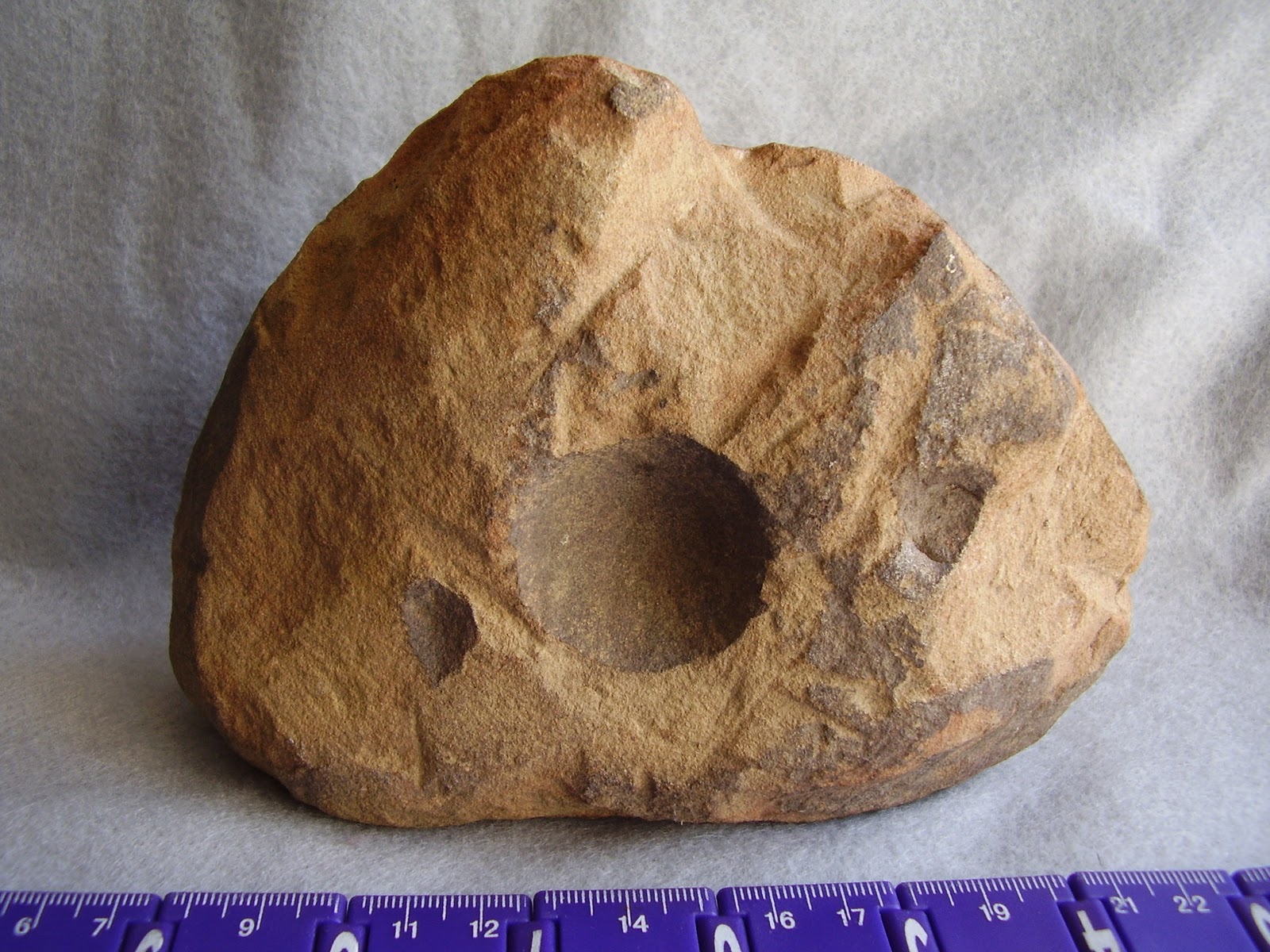
This cupule stone #2 was discovered 3 weeks ago in a display case at the Buckeye Lake Historical Society Museum.  A special thanks to museum director J-me Braig for arranging to loan me the artifact for photography and examination. A second cupule on the reverse side, like stone #1 has, may have been removed by plow action.  Just a tiny bit of the absolute bottom of a possible second cupule is found on the reverse side, exactly opposite the cupule seen in photo above.
Both Ohio cupule stones were found along the modern day shoreline of Buckeye Lake, a former Ice Age glacial terminus swamp/lowland, ephemeral lake area.  The cupules were found about 5km distance from each other.  Buckeye Lake is about 8km from the Burning Tree (golf course) mastodon find site.  So, there is record of human/proboscidean contact very close to the find sites of these possible mammoth sculptures.


Mammoth cupule stone #2 at left, #1 at right, seen side by side for similarities in raw materials, cupules and "mammoth form" perhaps as intended as the cupules themselves.

To establish precedent creation of single cupule, portable, zoomorphic sculptures, from Neolithic age in Europe please see Don's Maps site for photos of "Altar from house No. 45, Lepenski Vir Ib, carved in the likeness of a fish, possibly a carp. Photo: "Lepenski Vir" by Dragoslav Srejović 1972." The site is located in modern day Serbia.

http://www.donsmaps.com/lepenski2.html


A cupule with touching meandering groove, from Auditorium Cave, Bhimbetka, Madhya Pradesh, India.  It dates from 290,000 to 700,000 BCE.  It seems so interesting that the behavior of creating cupules dates back so far in the "old world" and may have persisted into, or re-emerged, in North America.

Perry County, Ohio

06 October 2011

"Sir Nameless"

 "Sir Nameless" pictured with his shadow.
Silhouette sculpture on stone plaque shows faces on both sides
Licking County, Ohio, find by Ken Johnston and Lyn Niday

This facial profile sculpture is from a newly disturbed soil context from construction activities at a tree park about 5km from Buckeye Lake in southern Licking County, Ohio. The context was sterile of glacial deposits and had only native Ohio bedrock-type limestone and sandstone objects and naturefacts.  The immediate context (3m radius) also produced a couple of crude tools, coarse stone lithic debris and two other suspected art pieces (a bird and a feline) which will be the subjects of future postings on this blog.  "Sir Nameless"- Beautiful, narrow, facial profile sculpture shows faces on both sides, named after the 

Thomas Hardy poem, "The Children and Sir Nameless"

Sir Nameless, once of Athelhall, declared:
"These wretched children romping in my park
Trample the herbage till the soil is bared,
And yap and yell from early morn till dark!
Go keep them harnessed to their set routines:
Thank God I've none to hasten my decay;
For green remembrance there are better means
Than offspring, who but wish their sires away."

Sir Nameless of that mansion said anon:
"To be perpetuate for my mightiness
Sculpture must image me when I am gone."
- He forthwith summoned carvers there express
To shape a figure stretching seven-odd feet
(For he was tall) in alabaster stone,
With shield, and crest, and casque, and word complete:
When done a statelier work was never known.

Three hundred years hied; Church-restorers came,
And, no one of his lineage being traced,
They thought an effigy so large in frame
Best fitted for the floor. There it was placed,
Under the seats for schoolchildren. And they
Kicked out his name, and hobnailed off his nose;
And, as they yawn through sermon-time, they say,
"Who was this old stone man beneath our toes?"

-THE END-


"Sir Nameless" under camera flash illumination

Perhaps statistical mathematical analysis can be brought to bear on the subject of art candidate rocks such as this one.  There are approximately 12 edge lines comprising the profile of the face along the left side of the stone as pictured above.  Each of the edges is in proportionally correct size, shape, grading and angular alignment to compose a human face.  It seems statistically unlikely mother nature could do all the work to make a 12 point face at this level of exquisite detail.  One bad angle, one disproportionately sized edge, would impact the dramatic realism of this high art piece.  A second bad characteristic would have exponential degradation of the visual processing of the image as a "face."  It reminds me of something I read once:  how many bites out of a cutlet does it take before it is no longer a cutlet?  Only a human can sculpt an object like this.  The art and tool context of the find makes artificiality quite certain here.
  
With scale

Side 2 with scale

Thickness of stone plaque seen here


27 September 2011

Day's Knob, Ohio Archaeological Inventory site #33GU218, Guernsey County, has examples of portable rock art pigmentation and painting

Engineer and archaeologist Alan Day, of Cambridge, Ohio, brought the concept of mid-19th century Frenchman Jacques Boucher de Perthes' "pierres-figures," translated as "figure stones," to North America with his popular daysknob.com web site nearly ten years ago.  The real estate he purchased for his aerial radio antenna turned out to be high ground which was producing stone tools and as Alan deduced after researching the topic, stone art.
His web site home page is:
Alan writes on the subject of pigmentation at the Day's Knob  site:  "The above piece was taken to the laboratories of NSL Analytical Services in Cleveland, Ohio for compositional analysis by x-ray fluorescence spectroscopy.  It was determined that the dark material is a superficial layer of red ochre (iron-oxide-based pigment) quite distinct from the limestone.  The table below shows the elemental compositions of the lime- stone and the pigmentation:


"A painting on limestone, a more or less anthropomorphic figure.  Note the typical artificial incisions on the rock."

"An anthropomorphic painting (height 18 mm - 0.7") apparently in iron oxide on the edge of a sandstone rock .  Until recently, markings like these at this site have not been presented as paintings because of the insistence of some archaeologists that they must be the result of natural dripping onto a rock's horizontal surface.  This recently discovered figure, quite aside from its compelling appearance of artific- iality, is strong evidence to the contrary (confirmed by a professional geologist) since the image is on the vertical broken edge of the rock, perpendicular to its horizontal strata."

"The eye on this limestone horse-like carving was painted with the same material."

Please find more artifacts and more of the work of Alan Day, whose detection, description and presentation of archaeological anomalies must be given serious consideration and evaluation by archaeological science.

Portable Rock Art paintings identified by Alan Day, Day's Knob site, Ohio

A special thanks to Alan for use of his material and for kindly helping me understand my own anomalous artifacts and prehistoric art.

23 September 2011

Ohio Hopewell excavation at Turner Mound by Harvard's Putnam in 1885 located four pebbles in a grave goods context similar to 2009 Clermont County "crown of pebbles" site

Grave goods pebbles from Turner Mound Group, Ohio, 1885
Peabody Museum collections, Harvard University
Peabody Number: 86-32-10/A634.1

Display Title: Pebbles

I located what appears to be a similar example of stone pebbles being included in, now, two Ohio Hopewell burials. This second group of four pebbles was also found in a Hopewell grave goods context 125 years ago, in the 1885 Harvard University excavation by F.W. Putnam of the Ohio Turner Mound Group in Hamilton County (Cincinnati area).

Contributions of Frederic Ward Putnam to Ohio Archaeology

These Turner mound complex grave pebbles appear to be composed of a similar, white, talc- like substance as seen in the six pebble crown stones from a nearby Hopewell burial archaeological site worked ca. 2009 by Ohio Hopewell scholar John C.(hris) Rummel. Minerals in the pebbles may have had medicinal or healing uses or perhaps they were used as a funerary "make up" to lighten up the body. Meanings and purposes are often unattainable from the archaeological record but recognizing patterns such as amorphous pebbles in two separate Southern Ohio Hopewell burials is a start.  


Here is a link to the earlier posting I made about six similar pebbles found in a crown formation in a female Ohio Hopewell burial excavated by archaeologist Chris Rummel near Miamiville, Ohio, in Clarmont County.  Special thanks to Chris for making the artifacts available for me to photograph and check out.

http://portablerockart.blogspot.com/2011/07/pebbles-producing-light-sparkling.html

These particular stones were likely in their place and formation for a significant reason (or reasons). As W. F. Romain writes in his book SHAMANS OF THE LOST WORLD ,p 164, identifying seven possible Hopewell cremation steps, he describes number five as:

“5. Selected grave goods were placed in symbolically significant locations, requiring intimate knowledge of the symbolism of the grave goods and their preferred placement.”

Perhaps this posting can expand awareness of these seemingly amorphous pebbles which were likely carefully selected for grave placement but the kind of thing archaeologists could overlook.  Maybe this could lead to recognition of additional examples. The entire Hopewell sphere tradition lasted for about 700 years from 200 BC to 500 AD.

Hopewell tradition information from Wikipedia

20 August 2011

Worked flint resembles a crested bird's head and stands on a base to orient such a figure stone correctly

Worked flint resembles a crested bird's head, with an "eye" seen in this view, and stands on a nice and likely intended base to orient such a figure stone correctly
Artifact from Flint Ridge, Licking County, Ohio.  Find and interpretation by Ken Johnston.  One suspected artifact incorporating bird head imagery might be a fluke but with a couple of compelling birds having emerged from the Flint Ridge area in Licking County, Ohio, a possible motif here is worth further investigation and study.  Please also see the posting "Least Bittern" for what could be a similar execution of bird head imagery found in near proximity, 10 meters, from this possible crested bird head.  I have wondered if these simple nature based images could have been created for children to ponder and play with as "toys" or maybe they had another significance.  The possible intended bird imagery may be familiar to us, but uses and meanings are not attainable from rock art of the long past.

http://portablerockart.blogspot.com/2011/06/least-bittern-head-awaiting-feeding.html

Artifact is pictured on a centimeter (cm) grid for scale.  The beak on this side is lined with quartz crystals.


The Flint Ridge Knap-in, the largest gathering of flint knappers in North America, takes place September 2, 3 and 4, 2011, at Flint Ridge, Glenford, Ohio, just east of Newark and about 1 hour east of Columbus. That's Friday through Sunday of Labor Day weekend.  Hope to see you there!

09 August 2011

Two birds depicted in flint and quartz crystals on figure stone from Flint Ridge, Licking County, Ohio

Two birds depicted in flint and quartz crystals on figure stone from Flint Ridge, Licking County, Ohio.  Artifact found and interpreted by Ken Johnston.

This side of the figure stone resembles a standing water bird, with its wing and tail raised away from its body, connoting movement.  The bird has a ground crystal eye, and a crystal head.  Note how the little sculpture stands upright on a pedestal-like base.


With scale


The blue circle in this photo indicates where the crystal was ground down to differentiate that spot visually from the rest of crystal in order to make an eye.  The eye is in the perfect spot to depict a standing, long-billed bird in left profile view.  As most all art like this, nature offered up the ideal starting form and with some modification this piece of chert was brought to life.


In this position, the same artifact would never be recognized as an art piece worked on a micro-carving scale to depict two separate birds.  However, once the birds are recognized, this is a great view of the work to remove stone material to define a bird's beak.  The area of grinding to remove quartz material is seen highlighted in blue marking on this photo.  Click photos to expand views.


PLAY>
Watch this short video of this beautiful flint and crystal bird sculpture rotating slowly on a display turntable.  The video is a little fuzzy but combined with the photos will provide a good sense of what this figure stone is like in three dimensions and how much the crystals catch the sunlight.

10 July 2011

Grave goods pebbles producing light, sparkling, powder found in arch “crown” formation over head of Ohio Hopewell Culture female burial

Ohio Hopewell Culture burial pebbles.  John C. Rummel excavation, near Miamisburg, Ohio, Clairmont County.  In situ, the pebbles formed a crown shape over the skull of the burial.
Archaeologist and Hopewell Culture scholar John C. Rummel identified six pebbles placed as grave goods in a semi-circular, arch or crown, formation on the flat plane of the body over a female Hopewell burial he excavated near Miamisburg, Ohio, in Clairmont County.  John was kind enough to allow me inspect and photograph the six stones.  My most significant observation about them was they left a light yellow, powdery residue on my fingers which contained very small sparkling inclusions.  As one’s angle of vision changes, on the rocks or on the skin after handling them, the sparkles throw reflections and change as if twinkling.  After I shared this with John, he noted the Hopewell seem to significate darkness with underworld and lightness with the upper world.  It made me wonder if the pebbles could have used in mortuary practices to lighten the skin after death, like glitter make-up, which is done by various cultures even today.  They could then have accompanied the burial as a link to the upper world in the form of a powdery, sparking crown of pebbles. 


Rough illustration of the position of the six pebbles as found in situ with the burial.  Hopewell Culture burials were so carefully orchestrated it seems likely there was a significance given to the pebbles and to the placement in a crown formation over the head of the deceased woman.
Here is a link to more information about the Ohio Hopewell tradition:

Hopewell Culture National Park near Chillicothe, Ohio

07 July 2011

"Rick Prince noticed this siltstone object firmly embedded in an extensive shale wall about 18 m (60') below the terrain surface"

Alan Day writes: "Rick Prince noticed this siltstone object firmly embedded in an extensive shale wall about 18 m (60') below the terrain surface" in 1983, at Brownsville, Licking County, Ohio.
Brownsville is 5 miles or so from Flint Ridge, a large outcrop of colorful, high quality chert- arguably one of the finest in all of North America.  The sculpture hoard of seven large flint pieces found at Buckeye Lake, Ohio, seen at subtleartifacts.com (link on right side panel), one of which exhibits the "one eye open, one eye closed" motif, was found about 10 miles from Brownsville.

Alan Day, landowner and archaeologist at Day's Knob, Cambridge, Ohio writes: Several features of this stone resemble those typical of artifacts from the Day's Knob site (33GU218) and elsewhere.  These are:
- The crest over the forehead (see photos at top of page).
- One eye wide open, the other slanted and half closed (see photos at top of page).
- A simple face cut into the open eye

James B. Harrod, Ph. D. has documented the one eye open, one eye closed motif from multiple Paleolithic old world archaeological sites. Please see links to Mr. Harrod's articles and web site originsnet.org on the right side bar.

Harrod has written: "One day I had the opportunity to hand the 'one eye' sculpture that Ursel sent me to the late Roy Scheider, a skilled actor in TV, movies and Shakespearean stage. I said nothing other than: "what do you feel this stone is saying". He said (paraphrase) that it felt like the tragic vision of King Lear, one eye open is witness to all human doings and human suffering, one eye is closed in pain and and anguish over the human condition; also one eye looks inward, one outward. Also as the head is like that of a child, it also speaks of maintaining spiritual innocence facing the human predicament. I am reminded of the proverb of Jesus: 'Be wise as serpents, innocent as doves'."

More photos and information on this artifact are available at this link:


28 June 2011

Day's Knob, Ohio archaeological inventory site #33GU218, has produced a bird pendant among many other likely art pieces

Alan Day collection, Cambridge, Ohio

photo with scale


Reverse side of the bird pendant
Alan Day of Cambridge, Ohio, popularly (if one can say that about figure stones) introduced the concept of portable rock art with his web site almost a decade ago.  This example from Day's Knob is interpreted by Alan as a bird pendant which balances in viewing position when hung from a cord.  The hole also serves as the eye for a second bird on the opposite side of the artifact.  A third bird, with wings, is seen emerging from/as the beak of the two larger bird heads.
For more information, visit the Day's Knob web site at the link below.  Many anomalous artifacts are presented from all over the United States and from Europe as well.  

http://daysknob.com/index.html