Denisovan Ancestry in East Eurasian and Native American Populations

Showing posts with label TN. Show all posts

19 September 2011

Tennessee laughing pebble identified by Sherry Hill is similar to Italian example described by pre-sculpture and paleoart author Pietro Gaietto


Tennessee laughing pebble identified by Sherry Hill is similar to an Italian example identified by Pietro Gaietto of Museum of the Origins of Man


Evidence of the artist's grinding is present to make two eyes and a nose on the face.  The mouth may have a natural feature of a pebble but it now shows evidence of expansion by excavation and carving to create an ironic, laughing, expression.  A second, small, eyes, nose and mouth composing a face may be seen in micro detail in the circle highlighting the work on the left eye of the figure stone.

Sherry Hill has found and identified several art pieces among the typical flint knives and points she finds on the surface in the Doe River valley, Carter County, Tennessee.  In this view, the laugh expression could also be read as a giant scream or even a yawn.


American entertainer Jimmy Durante and his famous trademark "got'cha" facial expression (1893-1980)

Here, the artifact is shown on a 1 centimeter (cm) grid for scale

Carter County, Tennessee
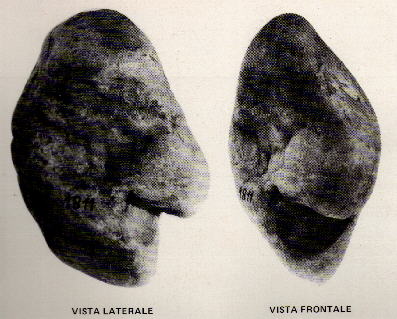
Allesandra, Italy
"Fig. 4.22) Lithic sculpture. It represents a human head without the neck. Strong stylistic deformation in ironic sense, deduced from the large nose.
Size: Height cm. 12.
Place of origin: Tortona, Alessandria, Italy.
Material culture: Mousterian, but perhaps previous.
It comes from an ancient alluvium of the Scrivia Torrent; it is damaged, as there are no more external traces of working. But the traces are present in the recess that constitute the orbitale zone and the mouth. The human type seems an archaic Homo sapiens, but it does not have chin, and the forehead is little. The style lengthens the head vertically.
Collection Museum of the Origins of Man."

09 August 2011

Crude cobble tool may have been modified to exploit shape to make a head and face figure stone

Crude cobble tool may have been modified to exploit shape to make a head with face sculpture.  Find by amateur archaeologist Sherry Hill near the Doe River, Carter County, Tennessee. Click on photo to expand detail.
Sherry Hill identified this as a possible crude cobble tool, in what would be similar to the tradition of Oldowan technology, taking a river cobble and making a couple of breaks to create a sharp working edge.  In addition to the focused flake removal here, it looks as if a face may have been created to take advantage of what the artist may have seen as a shape suggestive of a human head, with a serendipitous forehead and chin. The eyes may have been worked and the nose bridge between them was left alone and not ground away like the eye sockets.  The mouth area appears to have focused percussion to create visual differentiation of the stone in that place. 

This side appears to have wear indicating this flat, smooth, side was used for a rubbing type activity, as would be expected in food processing.  Maybe the face icon was incorporated into this tool so it could be seen and used in daily life. 

This kind of facial representation may indicate and expression of the lower to middle Paleolithic motif of "predator bite out of head" (Harrod, 2010).  So, the flaking to create the tool working edge is also the "bite" in the stone "head."  This same kind of mask stone is seen in a painting in a link on the right panel) to a Jan Evert Musch (archaeologist published on iconography) illustrated biography.

In the 9th painting here, the artist interprets some of the artifact types Musch has identified and one can see an illustration of a stone face, bite removed, like the one seen here.

http://www.behance.net/annekekoster/frame/688403

Thanks to Sherry Hill for submitting her finds so they can be appreciated on portablerockart.com!

26 July 2011

Kermit: Tennessee worked stone sculpture stands on a flattened base and resembles a simple hand shadow puppet and the head of the famous muppet, Kermit the Frog

Worked stone identified as a possible art sculpture representing a head and mouth by amateur archaeologist Sherry Hill.  The piece was found in the Doe River valley, Carter County, Tennessee.


The back of the mouth has been excavated and the convergence of the lower jaw and the upper palate is marked by a narrow and fine, deep, incised line running from side to side across the back of the mouth of the sculpture.
 

This rock struck an aesthetic similarity to Kermit the Frog's head when I first saw it and as I studied it more.  This got me thinking about the possibility of it representing a sock-type puppet, almost like a living, laughing, rock head.  As I studied the profile of my bare hand against the rock, I noticed both the outside of the rock, the part in contact with the hand when held, and the interior mouth outline of the mouth, both mirrored the outline created by the inside of my bare hand.  Here is a comparison of my hand aligned with the rock while in a position as if I would be making a simple shadow puppet.

Here is the flattened base the sculpture stands upright on

One of Sherry Hill's tool finds from the Doe River valley, Carter County, Tennessee.  This knife or hand axe appears heavily rolled by the environment which can be an indicator of great age or great localized forces (like blowing dirt or sandy water) acting upon the artifact, or a combination of time and heavy weathering.
Dennis Boggs find, Irrigon, Oregon, Columbia River valley.  This artifact also resembles a laughing head character.  It was identified as a humanly worked piece by Mr. Boggs.

View from above demonstrating the convex/concave nature of this artifact.  Jan van Es, archaeologist in The Netherlands, has identified convex/concave attributes as being significant to the artists of the Middle Paleolithic and very early Upper Paleolithic times in Eurasia.


Tennessee's Kermit alongside Oregon's similar looking artifact

The chase is on!

The First Bobblehead (see earlier posting of same name), at left, from Oregon, Kermit in middle from Tennessee, and at right another possible rock head with similar mouth representation from Oregon.

24 June 2011

Amateur archaeologists independently identify Oregon and Tennessee face-like icons exhibiting similar left-oriented, smiling, look

Sherry Hill find, Carter County, Tennessee

Dennis Boggs collection, Irrigon, Oregon
artifact is pictured on a centimeter(cm) grid for scale
In the first example, the lip begins just slightly right of the vertical center line of the face.  Most of the smiling lip line is oriented toward the left side of the face (right side of photo).  In the second example, the entire lip line is seen in this photo, all of it on the left side of this face stone. The suspected artifacts are about 6cm and 5cm in length respectively.

09 May 2011

Feline head in relief on stone panel, other art, reported by Sherry Hill, Carter County, Tennessee

Feline head in right profile, relief on panel, Carter County,Tennessee.
Sherry Hill collection
(click this photo to expand view)

Sherry Hill, an amateur archaeologist in Ritterstown, Tennessee, reports finding several anthropomorphic and zoomorphic stones in a relatively small area, which she cannot attribute to coincidence.  They are found near the Doe River, in Carter County.  This is with scale.


Artifact viewed from an angle as if from "behind the cat"

A second artifact, interpreted as a human head in left profile view by Sherry Hill
(photo is blurred but imagery is still "clear")
 
Ken Johnston interprets a mammoth head bump cresting the human's forehead

Finding multiple pieces like this in close proximity, as Sherry has done, lends support to 'artistic intent' in the "human agency vs. nature-fact" question.  More of Sherry's finds to be featured in the future.  Thanks, Sherry!