Denisovan Ancestry in East Eurasian and Native American Populations

10 May 2016

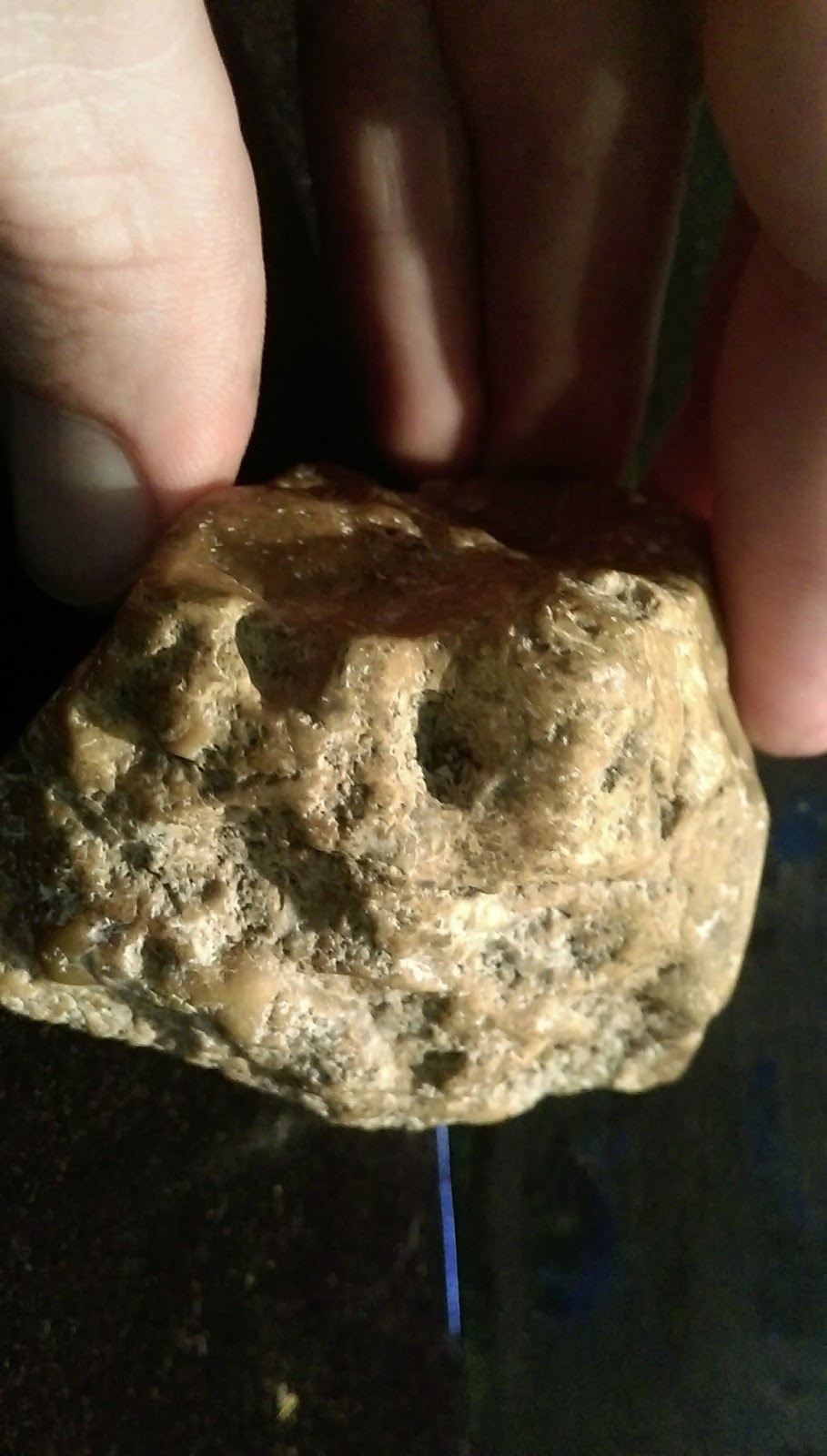
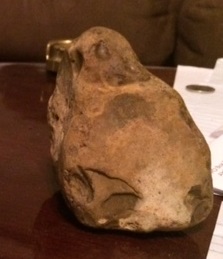
Three crude portraits found among Lower Paleolithic tools on the Île d'Oléron, France

Henri Valentie finds, Island of Oleron, France

"Hello, I present these portraits whose dimensions are 22/18/15, 25/13/16, 17/14/7. These stones come from the same site on the island of Oleron.

On the first one can distinguish a face looking skyward. The third has a funny side.

On this site there are more than stone figures with lower paleo tools.

Was it a place of worship (the sea with large tidal coefficient)? Still passionate about your site, friendship, Henri"

I think it is possible the middle stone has a depiction of a right profile of a horse head and neck, with an 'eye spot,' across the human's forehead. This France find could have a motif affinity with the Virginia sculpture featured in the posting just prior to this one.

04 May 2016

A striking human head sculpture made by means of large flake removal from The Arkfeld Site, Clear Brook, Virginia

'Human head sculpture by means of large flake removal'
Adam Arkfeld find, Clear Brook, Virginia

Creation of a sculpture like this requires a remarkable skill set of the artist, combining intimate knowledge and mastery of the stone material as well a talented artistic sensibility we can appreciate today.

As with so much portable rock art, more is often going on than first meets the eye. I interpret a horse neck and head figure nested in the human head sculpture above the person's forehead.

Please note what may a crude animal face depiction on the right side edge of the first photo. The creature's nose is a dark spot at the furthest tip on the right side. This is similar to other finds from western Europe and north west Africa. This suggests a connection of the North American Arkfeld Site to 'Old World' Acheulean or Mousterian in the Acheulean Tradition (MTA) art and tool complexes. (click photos to expand).

Photo one circles the animal head and photo two features the animal head with interpreted and illustrated features of its eye, nose and mouth.


'Heavy duty rhomboid burins'
Arkfeld Site tool finds, May 2016

03 May 2016

Standing animal sculpture from Virginia incorporates rhomboid shape found site wide

'Animal figure facing left'
 Adam Arkfeld find, Site #44FK731, Clear Brook, Virginia

Because of the large number of animal sculptures found at this site it is not unreasonable to make a zoomorphic interpretation of a stone with very subtle features like this one. While the 'body' of the animal is an abstraction as a rhomboid, the 'head' is very detailed with ear, eye, mouth and a prominent nose. It seems likely to be a depiction of a bear.

A couple of years ago I made a posting about some giant diamond-shaped plaques found at the site by Adam Arkfeld. If one 'cuts off the bear's head' as suggested by illustration above, the (more or less) rhomboid may be observed.

An object such as this may be incorporating a combination of figurative and geometric elements which were significant to its maker.

Simple face likenesses on worked stones blurs the distinction between 'tools' and 'art'

Clayton Elliott finds, St. Joseph, Missouri, Buchanan County

28 April 2016

Some of the many faces of the Ice Age Arkfeld Site, Clear Brook, Virginia

'Limestone plaquette, human head facing left'
Adam Arkfeld find, Site #44FK731, Clear Brook, Virginia

In addition to the head and neck profile in the overall shape the sculpture, there are two additional 'heads' depicted on top. This sculpture has three 'noses'. The 'eye' on the face circled in the upper right is trace evidence of pigmentation. The eye is obscured on the 'shadow face' with the nose highlighted in white.

'Face on rhomboid' a known portable rock art motif


'A smiling figure stone' with two nostrils in its facial detail. Maybe the figure is depicted as 'winking.' Perhaps a figure like this was a child's novelty or toy, a kind of Paleolithic 'Casper the Friendly Ghost' character. Adam Arkfeld describes it as having a purple hue which may be pigment residue.

23 April 2016

Ohio amateur archaeologist identifies human head sculpture found among artifacts and finds comparable example from the Swiss Alps

Adam Robinson find, Stark County, Ohio

Adam writes: "My elevation is almost 1300ft and the surrounding area is 850-900. I live on a plateau called top of the world. I don't think my land was glaciated, I think it caught a lot of runoff and deposits but never carved. There's fossil sea life still in the ground only an inch below the soil. Everything I have matches Acheulean and Mousterian artifacts. Very strange."

Ken Johnston illustration of Adam's interpretation along with possibility of the human head mixed with an animal head facing to the right. Faint traces of the human's mouth and an incised eye are highlighted.

"Many human faces in Paleolithic art look a little like those of large mammals, with an elongated nose or muzzle. These are my drawings to illustrate the character or flavor of this gradient"
(c) Copyright R. Dale Guthrie, "The Nature of Paleolithic Art," 2005, page 92


A couple of bird figures identified by Adam

'Sitting bird figure'

A worked flint from the site with possible human face profiles on two sides. The arrow illustrates the 'eyesight line'. The photo at right has a possible face in left 3/4 profile on the left edge.

 A battered and broken anvil stone reconstructed by Adam Robinson

The artifact at upper left is limestone made on a prepared core using Levallois-like technology.

Stone tools identified by Adam Robinson

American handaxe identified by Adam as similar to some Acheulean handaxes

A worked quartzite flake and a worked piece of red ocher from the site. Red ocher was often used in the Stone Age as a pigment for use in decoration, ritual and body paint.

18 April 2016

Korea example of hand axe with a face profile on its mid right edge bridges the geographic gap between European and American examples

'Korea hand axe with crude human face profile looking right'

Korean example of hand axe with a face profile in its mid right edge bridges the geographic gap between European and American examples as recently featured on this blog.
The Paleolithic Age, which can be regarded as the first cultural stage of humankind, began with the manufacture of tools and the use fire. It is estimated that the Korean Peninsula came to be inhabited by humans from the mid-Pleistocene, approximately 780,000~130,000 years age. These paleolithic communities consisted of hunters and gathers who maintained a mobile lifestyle. They established camps in caves or alongside rivers and made various tools.

 Illustration highlighting the human head and face in right 3/4 profile perspective.

This new example from far east Asia implies a culturally mediated figurative art motif incorporated into hand axe tools by Homo erectus or other archaic humans spanning Africa, Europe, Asia and possibly into North America. This is counter to the popular belief such humans were not capable of figurative art.

14 April 2016

A two-sided turkey vulture head with two human face profiles incorporated onto its backside from Flint Ridge, Ohio

'Two-sided turkey vulture head with two human face profiles incorporated onto its backside.'
Ken Johnston find, Flint Ridge, Licking County, Ohio

Side 2 of a likely turkey vulture head depiction. The material is Vanport chert.

Human face right profile on the back of the vulture head.

Close up of human face right profile reveals intense flint work on a very small scale. These artifacts call for extremely close scrutiny of worked stones near major stone quarry sites like Flint Ridge for iconic properties.

The face has received flint work attention which cannot be accounted for in an endeavor to make a tool. This stone seems wholly unsuitable as tool stone. It has been deliberately shaped, it resembles a bird head on two sides and has two human face likenesses when they have already been associated with the backs of bird figures on this blog here and also here. This Ohio flint bird is very similar to one from Italy, described by Paleolithic sculpture author Pietro Gaietto.

The Ohio bird was found in the same general location as several other flint bird head figures.

I have also described human facial profiles worked on flint edges. This is an example in the Flint Ridge material with a profile on each side of the stone like this one.

It should be noted that Jacques Boucher de Crèvecœur de Perthes specifically described bird heads as among the iconic materials he found alongside tools in the Somme valley of France in the mid 19th century.

Turned upside-down the turkey vulture head resembles a sitting bird with beak turned up to accept feeding

The flint compared with a turkey vulture head

Here is another human facial profile, looking leftward, worked into the flint on the backside of the bird head. Note the prominent brow ridge which suggests a more robust human type.

In its totality this object and its context proves a Stone Age art enterprise at Flint Ridge which, among many motifs, incorporated combined bird and human forms.

12 April 2016

The Old Route 66 Zoo reveals more stone human head likenesses from a half-acre site

'Zooanthropomorphic face with animal-like left ear'
Stacy Dodd and Rod Weber find, The Old Route 66 Zoo, Site #23JP1222

Note the lighter 'eyes' and the reddish 'nose' on the face like figure which is looking to the upper left corner.

Another anthropomorphic 'face mask' from the OR66Z Site, Jasper County, Missouri (Missouri local archaeological inventory number).

An examination of these stone sculptures can confirm Stone Age modification.

11 April 2016

More of the 'mammoth with human face on posterior' motif from The Arkfeld Site

'Mammoth right profile with human face depiction on its posterior'
Adam Arkfeld find, The Arkfeld Site, #44FK731
Clear Brook, Virginia

One of many mammoth sculptures from this site. This one could be depicting a mastodon based on the head and body shape. Adam describes the sculpture as smoothed by extensive handling and ocher stained. He detected a human face likeness on what would be the posterior of the mammoth. The mammoth body is seen in right profile with the human face in the lower left corner.

'Human face on mammoth posterior'

08 April 2016

Stone head and pendant in close proximity from the Island of Oléron, France

Henri Valentie finds, Island of Oléron, France, on a Lower Paleolithic site producing other finds featured on this blog. "You can see many faces on this left profile" writes Valentie. 38/30/20 cm.


A stone pendant with bi-conical hole found on the same site on the same day on the Island of Oléron. 7/6/4 cm. Henri Valentie finds.