Denisovan Ancestry in East Eurasian and Native American Populations

01 April 2011

The First Bobblehead! An engineered figure stone “laughs” with kinetic energy for 25 seconds after being touched

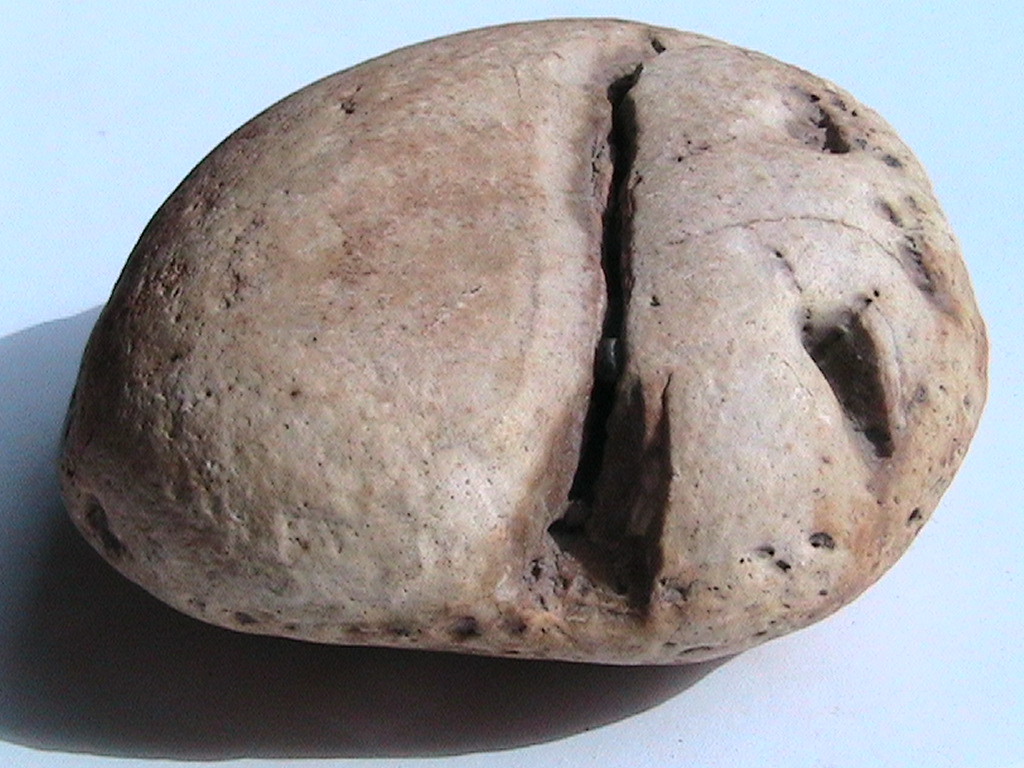
The First Bobblehead.  An engineered prehistoric figure stone “laughs” kinetically for 25 seconds after being touched.  Dennis Boggs collection, Irrigon, Oregon, U.S.A. Analysis and interpretation by Ken Johnston.

This rock is designed to be a moving, laughing, stone figure.  It is a cartoonish depiction of a head and mouth, somewhat like a PAC-MAN figure.  The stone has a carved ledge which serves as the “lower lip” on the laughing face.  This lip wraps around part of the stone at an angle which seems to depict a smirk or grin.  There is a tongue depicted in bas relief on the palate and a tongue depicted in sunken relief on the bottom of the mouth, giving it a life-like appearance of looking into the mouth of a laughing person with “their tongue on the roof of their mouth.” There appears to be residue of a reddish pigment in the tongue/open mouth area.
The Wikipedia description of a modern-day bobblehead is somewhat apropos.  “A bobblehead doll, also known as a bobbing head doll, nodder, or wobbler, is a type of collectible toy. Its head is often oversized compared to its body. Instead of a solid connection, its head is connected to the body by a spring in such a way that a light tap will cause the head to bobble, hence the name.”

The bottom of the rock has two curved rails it is able to toddle on.  These rails have been worked to maximize the kinetic activity of the stone after being touched.  These are “rockers,” like on a play-horse.  The stone was made to balance precariously on the rails and to rock smoothly after being touched so as to continue in motion for 25 seconds, an extraordinarily long time for --a stone-- to move, in place, without having been engineered to do so.  It was probably a “joke” stone or a “novelty” stone at least, and may have served a more serious role as a puppet-like presence of the enduring mythological role of the character “the trickster.”

The bobblehead has been designed to be "inertia seeking" over a longer than anticipated time- thus becoming an object of magic.  In a possibly animistic view of the world, this particular rock would certainly be seen as "spirited with life."


There is an aesthetic similarity of the smile or smirk on the bobblehead to the one seen in the posting of the “The Trickster” in February.  While both were found near Irrigon, Oregon along the Columbia River, and may indicate a shared perception or artistic sense of the grin/smirk, these pieces were “field finds,” out of their original context, and whether they shared relative time and space while in use is not known.
(click on any photo to enlarge)

This is a view of the rocker rails on the bottom of the figure stone which have been engineered and worked to enable it to balance precariously and continue wobbling for 25 seconds after being touched.

Watch this 30 second video of the figure stone in action!


-kbj


A POST PUBLICATION QUESTION
One of the visitors to the video has posed an excellent question:

Question: Very interesting the specialised shape of this artefact object. Indeed it moves for 25 seconds when touched. My question is if they had stable, flat surfaces to put the rock on. I think maybe you try the same at a slate palette, or a similar natural surface to see the moving of the artefact? It 's not that I'm not convinced of the principle- stone age people are very much the same as we are!- but how does this work on a natural surface?
Answer:  This question is likely based on the observation that the rock in the 25 second video has the benefit of having been filmed on the fine porcelain finish of the top of my toilet tank.  The answer is that the rock does display the kinetic property, but for shorter periods of time, on rougher surfaces. 
Rather than touched and left alone, I think there was perhaps a desire,  like with modern day bobblehead-touchers, to keep the head moving (e.g. placement on the automobile dash.)
I hypothesize the stone was more likely continuously manipulated on a somewhat flat surface (not a perfectly flat surface) in a lever type action which could keep the figure laughing indefinitely.  There is a “front stopper” which allows the stone to “laugh on the rocker rails” and learch forward, if moved too much, onto another surface, which will “bounce” it back onto the rails, without toppling forward.  This allows one to “ensure” the stone keeps moving without rolling over.
In this video demonstration, I use a slab acquired from a prehistoric cultural site which presents a nice “handle” from which I manipulate the slab in "push-button" fashion while a small pebble rests underneath to provide a fulcrum mechanism. I manipulate the bobblehead stone and show that it can be maintained for near a minute (an hour, a week with a team), and then at the end I let loose and let the rock bobble on the completely natural surface where the kinetic movement may still be seen in action.  This natural surface is not particularly smooth, although it is relatively flat.  It, or another stone, could be smoothed to a polish close to the porcelain one if desired, where the 25 second kinetic movement could be approximated or exceeded.

This is the slab stone, and flat pebble in lower left, used to create a "natural" lever mechanism to allow one to keep keep the head moving as long as attentive to it.

The lighting scheme in the stone surface video is 100% wholly reflected, and pure (from clear glass bulb), incandescent lighting.  This lighting seems best to bring out visual attributes which may be noticed if the rock art is viewed fireside.  The video with bobblehead on the stone slab shows a lightened "rim" along the lip of the figure so a mouth is visible in low level light.  There appears to be two light stone eyes staring out from the darkness on the front of the stone above the mouth.  This is visible in the still shot on the YouTube PLAY> screen, and also during the video itself.

Thank you for the question. 

-kbj

IMPORTANT COMMONT FROM ANONYMOUS:

ken...
i have several 'bobblehead' creatures...seals,and birds...i have placed them in flowing rivers/streams...or at the edge of the ocean and noted they 'wabble' with the flow of the water...they look rather alive when seen moving around seemingly on their own.

22 March 2011

Motif persistence and transition from Low Paleolithic to early Upper Paleolithic observed by Jan van Es


From Jan van Es, The Netherlands
"At the right of the photo the well-known corpulent Venus of Willendorff; 29.000 BC.  

At the left the Low Paleo, strong patinated face/Venus (Beegden, The Netherlands). It's a find of 1981 and I found it together with Low Paleo artifacts (350.000-450.000 BC).
 
"The man's face is also representing a skull with gaunt eyes and an open mouth spitting out an egg."
 
-kbj)

19 March 2011

Face with incised and chipped mouth

Face with an incised and chipped away mouth
Dennis Boggs collection.  Irrigon, Oregon, U.S.A.

The technique to make the eyes and nose here seems similar to the technique used to make the eyes of "The Trickster" posted in February.  An incision was made along a line to depict the mouth and then stone was chipped away under, and up to, the line.  The visual affect is a more life-like mouth than a straight incised line alone could provide.

-kbj

14 March 2011

Worked flint gorilla-like primate and horned bovid (with multiple faces)

Worked flint resembling a gorilla-type primate.
Dennis Boggs collection, Irrigon, Oregon, U.S.A.


When the view of the pierres-figures is changed slightly, the animal morphs into a horned bovid, presumably buffalo or musk ox, known symbols of "male fertility" and "masculinity" in early stone art.  The nose of the buffalo in profile is at the far left of the artifact, they eye is above that and a curling horn icon is above the eye. (A coin is being used to stand up the artifact for some of the photos).


This is side 2, the back of the stone


Test your skill.  Do you see any faces or other images on the gorilla/buffalo? Click the picture above to expand for details.


Here are three faces I detected on this stone. Primate face being seen straight on inside circle around head.  Child or woman in hat/leered at by devil man, is seen in the pentagon.


Child or woman in hat, on left looking to lower left of screen,  being leered at from right side from slightly above by left facial profile of a "devil-man" with a grotesquely exaggerated nose.  Other possible faces on this stone, such as the one outside and just below the left point of the pentagon, are 1 to 2mm round- almost rice grain art size.

-kbj

Face on front of abrading stone using contrasting white stone for jawline

From Irrigon, Oregon, U.S.A., Columbia River Valley
Dennis Boggs collection

Smiling, chimp-like face on leading front of abrading tool


This is a view of the hard stone material on the bottom of this piece used as the abrading surface on this finger held pebble tool.  The top of the stone which comprises the face is a softer, much different stone type.  This is a view from behind of the left profile of the face, tip of the face's mouth is point where at left where the two materials meet.  One would grab the "knob" seen here on stone top and hold with smiling face leading each forward stroke of the abrading tool. 


View of right side of face.  This face incorporated into a tool in the U.S.A. may indicate a Eurasian cultural connection to the maker.


From The Netherlands, collection of Jan van Es
Oregon example exhibits similar usage of different stone material to make the jaw line of the face.
 
-kbj

07 March 2011

A polymorphic sculpture: ape, lion, duck, egg, elephant and face "mask"

Ape head, right facial profile

A polymorphic sculpture:  ape, feline, duck, egg, primate face "mask" and proboscidean

This likely prehistoric polymorphic sculpture came to my attention by an internet visitor to Portable Rock Art as a possible intended “ape” icon.  The base it now stands on has been cleanly cut by a power saw in modern times apparently to facilitate standing display of the stone, which is quite interesting and beautiful not considering the imagery.  It was gifted to a rock collector without any records.  There is no provenance on the stone, it has modern alteration and it must be duly qualified.  Nonetheless, it is quite interesting and I think suitable for introduction and discussion here.  In addition to the ape, I have interpreted four additional creatures in this sculpture.

Anyone familiar with the stone material and its possible origin, which seems like a type of banded onyx or marble, is invited to comment or send an email.  It is very heavy for its size so the stone density is high. It is best to warn others of its unexpected weight when handing it over to them or they tend drop their arm and swing it back like they’re ready to “bowl” the artifact across the room. The surfaces, other than the cut part, are in excellent condition.

Feline head left profile.  The black band is the cat's jawline, her mouth, at lower left of photo, is represented by an excavated hole to suggest a snarl out of the side of the mouth.

There is also a depiction of a "sitting  duck" integrated into the image of the lion's head.  The duck is sitting on the jawline's wide black band which becomes like a shore's edge, facing left, bill tucked to its breast, with the black spot at the top of the stone representing the duck's eye.  There is an incised triangular wing.  The tail of the duck, if there was one, has been lopped off by the saw cut.  The duck is depicted as sitting on a likely symbolic "cosmic egg," source of life.  The lion and/or facial mask,  depending on the view direction, is positioned to spit out the the egg, a regenerative theme in early European stone art described by archaeologist Jan van Es of The Netherlands.

The appearance of at least five creature images at each of the four cardinal-type views of the artifact suggests its likely prehistoric intended iconography.  It was probably naturally suggestive to an artist or artists who made alterations to follow those suggestions to further refinement.  They are interpreted as a feline’s snarling head (like a lion), a primate (ape or human) seemingly depicted with a traumatic injury to the left side of the face, an ape-like right facial profile, a standing probiscidean (elephant, mammoth, mastodon family) and a duck.

The rather obscure public recognition of the roles of these five  "morphs" in ancient stone art make it unlikely someone would intentionally manufacture such a stone in current times.  It seems very likely only someone with great exposure to stone material offered by a hunter-forager's intimate relationship with and knowledge of lithic resources, as well as a great culturally-driven desire to express these five creatures simultaneously, could produce the final form seen here. It is a combination of iconography and a craftsmanship of another time.    

The most obvious human activity documented besides the saw cut is drilling and expanding of the lion’s mouth to manufacture a look of “snarl” or “grrrrrrr”  out of the side of the mouth.  There is a definite area of focused multiple percussive blows on the forehead of the ape, just above the right eye.  The ape's mouth line seems partially incised.  The ape's eye area was excavated down to black stone and recessed under a natural stone inclusion serving as a hard brow line.  White stone was removed to access black stone underneath to make the two eyes of the elephant. The primate face mask has two ground stone nostrils. The duck likewise has white stone removed to depict an eye in exact location.

The piece appears polished, maybe resulting from a combination of environmental rolling, intentional polishing of breaks made to enhance the final form and smoothing and patination from human handling of the stone.

Primate (ape/human?) "mask" with grotesque/missing left facial depiction.  Two nostrils are visible at the tip of the nose here, face is being viewed straight on.  Each serves as the singular nostril for the profile views of the lion and ape.
(for orientation, ape on photo left side, lion on photo right side)

The idea of a lion taking a bite out of the head may be found in the “Four Memes…” article by James B. Harrod seen in the links panel on the right side of your screen.  Such stone faces, or masks, are often depicted with visual distortion on the left side, often indicating an open mouth, a closed or missing eye- perhaps suggesting the horror of a lions bite.  This artifact could be an expression of a “stratigraphic overlay” of three world “memes” or packages of cultural information (1) "hit the baboon (ape here) on the head," first identified by Mary Leakey at Olduvai, (2) “lion's bite out of the head” and (3) “mask of the opacity of suffering” to borrow James B. Harrod’s concepts and terminology. 

Standing elephant, head at photo left side, rump at right 

A slice of the stone was cut off by power saw in current times, about parallel to the horizontal plane of the standing elephant, where the lower 1/4 or so of the elephant, such as the bottom of the trunk, the bottom of legs and the feet, if they were ever there, are gone now.

Head-on view of elephant, eyes depicted in black stone

Apes are a known subject of European stone art.  There may have been human networks from Europe into Africa or Asia which provided information to Europeans about apes.  Some Europeans were very familiar with baboons which they had to contend with on the Iberian Peninsula and along the Mediterranean coast.  It may be that the remains of bones, such as those of Gigantopithicus which went extinct about 100,000 years ago, were traded into Europe from south east Asia as novelties of a much larger but similar species. 

Please use the links here for images and more information on the ape topic in ancient stone art.  Right click your mouse to have your browser translate languages if needed.

Ursel Benekendorff, Germany

Hans Grams, Germany

Jan van Es, The Netherlands

Petrified wooden polymorph from Java.  Jan van Es collection.

-kbj 

06 March 2011

Fossil-featuring by artist at center of pressure-flaked “flower” on a tool

Fossil-featuring by artist at center of pressure-flaked “flower” on a finger held abrading tool.  From Irrigon, Oregon, U.S.A.
The chert here is a beautiful orange and rose color with little black fossil or mineral inclusions.  Information from readers on the inclusions would be appreciated.  When the flint is held to light, the inclusions (hereinafter “fossils”) become visible inside the stone.  This translucence and suspension of visible material in stone may have been fascinating or meaningful to the maker of this tool-with-art (or art-with-tool) object.
This fossil, resembling “Gumby’s legs” in shape, is featured inside three to four pressure flaked “petals” which seem to feature the fossil at center like an open flower.  The stone was removed incredibly precisely at two angles to reveal the two fossil surfaces, each precisely flat and exposed.  When you look at the surface it looks like you are seeing the surface of the fossil itself with all other stone removed and no damage done to the hair-thin fossil whatsoever.

Possible micro-drilled fossil access bore holes on this artifact, and others of the same material to be more closely examined, seem to be disproportionately directed at the fossils from the closest surface plane or from one surface plane.  One would expect a more random showing of hole directions if they were of natural formation.  Maybe they were made to “free the fossils” or “access the impossible” or simply as beautiful curiosities to look at while performing abrading work, likely in personal food processing based on tool size, form and wear surface.  Wear surface in photo above right.
There is a divot hole made on the leading end tip of this tool for placement of the tip of the index finger during optimal grip of use.  Photo right is looking down on the tool, divot for index finger toward top right of tool.  The "flower" is hiden from view on the backside of the tool as seen at right.


Tool seen at left as held while in use, flower icon and fossil visible to the tool user.

 
For related information on this topic, please see a work of John Feliks, Ph.D., a founder of the Pleistocene Coalition, titled “The Impact of Fossils on Visual Representation:”
The oldest and most famous example is the “West Tofts handaxe” which features a scallop shell fossil at its precise visual center (please see another John Feliks article below).  The Irrigon, Oregon, USA, artifact from the Dennis Boggs collection displayed here seems to likewise feature a “frame,” but in the form of pressure-flaked “flower petals” around the accessed fossil.  Flaking away the worn surface of the flint nodule, which has a "frosted" surface due to environmental contact, enhances its translucence in that area, giving the petals of the flower a somewhat "brighter" appearance than the surrounding stone.  The petals are like glass windows into the flint material.


-kbj

03 March 2011

Branching lines incised on a Golden Composite Ellipse shaped stone


Branching lines incised on a Golden Composite Ellipse shape.
Irrigon, Oregon, U.S.A., Columbia River valley.
Dennis Boggs collection.

(please reference pages 27-38)

"The Deep Roots of Some Aspects of Aesthetic Design," Alan Cannell

Side 2

-kbj

22 February 2011

"From Face to Venus" of Jan van Es (on big egg) from North America

"From Face to Venus" carved on big cosmic egg

When this stone was received in the Dennis Boggs collection from Oregon, U.S.A., it became one of the first to be closely examined because of its large size, unique egg shape and possible relatively explicit intended iconography.  It is also one of Dennis’ favorites. If it was an artifact, it was, to me, quite obviously representing the left profile of a man’s face and maybe more. 

When I showed it to my girlfriend, initially without prejudice, she said "I see a woman."  I asked "Do you see the man's face?"  She replied, "Yes but I looked past it."  She went on to explain the female imagery, which I had unsurely noted. If one shifts visual attention, a man's face profile and alternately a woman's body profile may be seen.  She further described seeing a family, together, in the image because of what looks like a few legs/feet on the “ground” of the image, looking maybe like a child in tow, along with the man’s face and the woman’s standing body profile.  Only then I recognized the possible kid.  When I asked Brennah, age eight, what she saw while I pointed to the image details, she replied without hesitation, “A giant egg.”  


A physical examination of the image under 10x lighted magnification shows likely areas of stone removal to create the fine details of the profile.  It looks as if there was a natural crescent shaped gash in the egg shaped rock and the gash was used to guide a chisel-like tool down into the stone to remove selected parts to make the image.  Today, the gash has two surface types, the smooth "original" or first gash and then a rougher part representing where detail stone was removed by the artist.  Or they represent two stone removal techniques used to create the gash then refine it to completion.

One of my avenues of inquiry was to revisit the work of a man in Europe who I was aware had made research of the “egg” motif in figure stones.  Jan van Es of The Netherlands began investigating figure stones exactly 40 years ago. I re-discovered he writes at his web site:
“During all those years of research I noticed that, besides all forms nature offers in rocks, trees, fruit, animals etc., the egg-shaped rocks were considered as the most ideal kind. The big cosmic egg, the germinal force and origin of life, seems to have been a very important notion and turns out to be a main line in the images.”  

As I browsed his home page, I came across a pencil sketch he made representing a composite image of another significant theme he has identified.  The sketch is titled “From Face to Venus.”  

For me, it is as if the Oregon, U.S.A., artifact image was one of the subjects composing the idealized drawing.  According to van Es, it represents a man's face, his nose also the breast, his mouth also the vulva, of a standing woman, representing together the breath of life. They are indeed depicted on this figure stone with a child, whose legs and feet are seen in the photo above the sketch (above) but wear may now have obscured the rest of the child's body image if there was one.  This polymorphic art sculpture was an object of a fertility ideology.
I experienced a great thrill of discovery as it became clear Dennis Boggs had found, and I had identified, a “From Face to Venus” carved figure and more- one integrated into a giant cosmic egg.  It is a western North American artifact linked to Middle Paleolithic Western Europe art traditions. It loudly calls into question the theories of the initial peopling of the Americas currently posited by mainstream anthropology.
-kbj

18 February 2011

The Trickster

The Trickster

Mr. Dennis Boggs of Irrigon, Oregon, has been collecting suspected crude tools and figure stones for fifty years on the valley floor above the Columbia River and below desired locations on mountain terraces to camp, observe migrating animals, etc. 

This example was examined under 10x lighted magnification and there appears to be intended work on both eyes and the mouth.  The stone was likely pre-historically found to be suggestive (the crack itself of the mouth looks natural) and then was “rectified” to complete it to the desired end form of the artist.  The entire length of the lower “lip” has been worked to turn the harsh edge of the crack into a more a more smooth, natural one.  This gives the upper lip an appearance of projecting slightly beyond the lower lip.  The smoothing of the lower lip cut another angled surface, like taking a 90 degree edge from face into mouth crack and topping it off with a 45 degree slope.  This slope has been worked but it has also been heavilly rolled (weathered, tumbled in abrasive soils, worn away somewhat) so it looks more rounded today than a 45 degree angle upon rectification.

Both corners of the mouth were expanded with stone modification to represent 'smirks.' The eye on screen left looks to be human-expanded  from a smaller natural indent. The eye on screen right may be wholly manufactured by a chisel type instrument.  Perhaps a couple of small pebbles may have been inserted in mouth crack to represent teeth but they could have been naturally stuck in the crack due to erosive wear.  What could be interpreted as a small “tear” is leaving the inside corner of the eye on screen left. He looks to be laughing ‘till he cries.   
In the photo at left, a lighter band of stone along the lower lip area shows where material was removed to alter the natural crack.  There are two vertical lines between the eyes perhaps etched to represent a nose.  The visual "flow" of the nose matches the "flow" of the face toward the larger grinning side.

In the Boggs Collection, there are also items I might not find in Ohio or from my mostly eastern U.S.A. contacts.  Sperm whale, grey whale, killer whale and porpoise are represented in the Boggs collection.  One anthromorphic and one zoomorphic figure stone artifact will be posted in coming months where in addition to photos, there will also be demonstration of these amazing "joke" or "entertainment" figures in moving video on YouTube.  
Thank you Dennis Boggs for submitting such an emotive human face figure stone and for making your collection of thousands of suspected artifacts available for close examination and study to us in Ohio and elsewhere.  We will be busy for a very long time.  More of the Boggs collection will be seen here, as it demonstrates themes and artifact types similar to finds at sites in the mid-west and eastern U.S.A., Europe and Asia. 
The view here is along the  mouth crack from left side of face (photo bottom) to right side (photo top).  The light stone band along the lower lip is where stone was removed to open the mouth up a bit.  A good shot of the dimple area modifiction here, or an expansion of the left end of the mouth (photo bottom).

Back side of the artifact.  Although it appears it could  present a second face, examination did not reveal any clear human work.  A face on the reverse of a relatively explicit face image should be considered for artifactuality.  However, without evidence of human modification here, it remains an unanswered question. It may be that analysis using magnification beyond the 10x I commonly use, along with the interpretive expertise to use that technology on stone, could shed more light on this.  -kbj