Denisovan Ancestry in East Eurasian and Native American Populations

Showing posts with label bird beak. Show all posts

21 June 2011

Another bird-like, beaked, flint from southern Licking County, Ohio

Licking Township, Licking County, Ohio
Ken Johnston collection
 

Bird-like flints with beaks can be found locally in the Buckeye Lake area.

Also pictured here are two flint, again somewhat bird-like, blades found within 10 feet of the beaked piece. These pieces were most likely not associated in pre-history but are staged together here to illustrate what seem to be avian shapes found in this locale in greater numbers than pure randomness should allow. Perhaps a pattern can be demonstrated with publication of more examples of this artifact type.
As the enabling (knife-like, spear-like) and first part of a bird to emerge into this world, these beaks may have had a symbolic significance expressed in flint and beyond their potential utility as tool attributes.
 
The topic of children toys in archaeology is rarely addressed but it is likely some rock art was used for learning and play.   A real bird is difficult for a child to hold but they are such a large part of the world of nature early people were immersed in.  Maybe these bird forms were a way to capture a child's imagination for a time.
three artifacts found at Hebron, Ohio, along Buckeye Lake, by Ken Johnston

reverse sides of the artifacts

all shown with scale

close up of beak-like feature

beak feature from opposite side of artifact

14 June 2011

Perhaps a Least Bittern (bird head sculpture standing upright on base)

Least Bittern head and beak, from Flint Ridge, Licking County, Ohio.
The artifact stands on a base with the beak pointing skyward, just like a living Least Bittern awaiting feeding.

artifact is pictured on a centimeter grid for scale and perspective
(click photo to expand)

Side 2
(click photo to expand)

side 2 standing


John James Audubon reproduction of the Least Bittern in its typical, beak pointing up position.  The flint sculpture here captures not only the look of the Least Bittern but also its most notable observable behavior which is the young clustering with beaks in the air awaiting the regurgitated food to be provided by the mother, heads swaying like the wind-blown reeds and grasses of the water's edge.  As soon as mother leaves to bring back and regurgitate food for the chicks, it's beaks up and moving to the rhythm of the long grass to camouflage themselves and be in ready position for her return.  For this reason, birds (and specifically beaks) are thought to be symbolic of new life and motherly sustenance.
The nesting Least Bittern is observable in the shore area of Buckeye Lake, Ohio, near Flint Ridge today.  When I saw the flint, my immediate thought without hesitation was "Least Bittern!!!" and then the painting on the wall of my study.  The artifact beak has a slight curve where the Least Bittern's beak seems more straight. It seems to be the closest looking species of water bird currently in Ohio and may have been the species in the mind of the creator of this piece of flint.
If not intentionally produced as a sculpture, the likeness to a bird could have been recognized in prehistoric times and resulted in the piece being set aside. The perfectly flat base and ideal standing position of the sculpture form argue for intent to create a presentable bird head sculpture here.


13 June 2011

Two examples of beaked, bird-like, flint artifacts from Licking County, Ohio, found at same cultural site

A "beaked" uniface.  Pam Douglass find, Jacksontown, Ohio
(please excuse the slightly blurred photos)
A beaked uniface.  This type of beak is quite common on artifacts in the Licking Valley in Central Ohio, giving them the look of a bird form.  The bird forms often have a concave back and a convex breast below the beak.  More examples to be posted in the future.  It may be diagnostic of a tool type, and/or it could be a way to express bird imagery.  The beaks do not appear to have been used so their existence may be wholly symbolic.  The other edges often appear to have been lightly used.  Also, other types of bird iconography may be found in the area of Flint Ridge, Licking County, Ohio.


with scale included in photo
Another beaked artifact has two, conjoined, egg-like cups.
It may be interpreted as a micro-sculpture of a pregnant woman's torso with legs spread in birthing position.
Pam Douglass finds, Jacksontown, Licking County, Ohio
This beak itself does not have any indication of use as a tool.

Micro-sculpture of pregnant woman's torso
top yellow line = truncation of the head 
bottom yellow line= truncation of the right leg
yellow arrow= woman's vulvar zone, source of human life
white arrow= left thigh.  Left leg truncated below yellow arrow.
grey line= bottom of belly of woman
white line= contours in the flint define top of pubic area
green arrow= pregnant and protruding belly of woman


Close up of the woman's torso sculpture representation of the vulvar area
The artist has exploited a naturally advantageous inclusion in the flint to represent the source-issuer of all human life.

The white stone feature with sparkling silver center which represents the vulvar zone on the other side of the artifact penetrates and narrows in the flint so it is seen on this side as a circle and dot (inside white circle markup in the photo above) as opposed to an oval with line on the "feminine side."  The blade edge on the left in the photo appears to have been used.  The suspected use-wear zone is inside a white bracket markup in the above photo.  (click photo to expand)
The cups appear breast-like at this angle.  The bird is associated with maternity and providing for the young in Paleolithic art and this may be an intentional symbolic creation of the of the birthing (eggs) and nurturing (breasts) mother motifs. The cups are concave on the artifact but if one looks at the cups as breasts, the breasts appear as if they are convex or protruding from the stone which is in fact an optical illusion.  Pictured with scale (mm) on photo right border.  The beak is highlighted in white lines here because it visually washed out into the background of the photo.
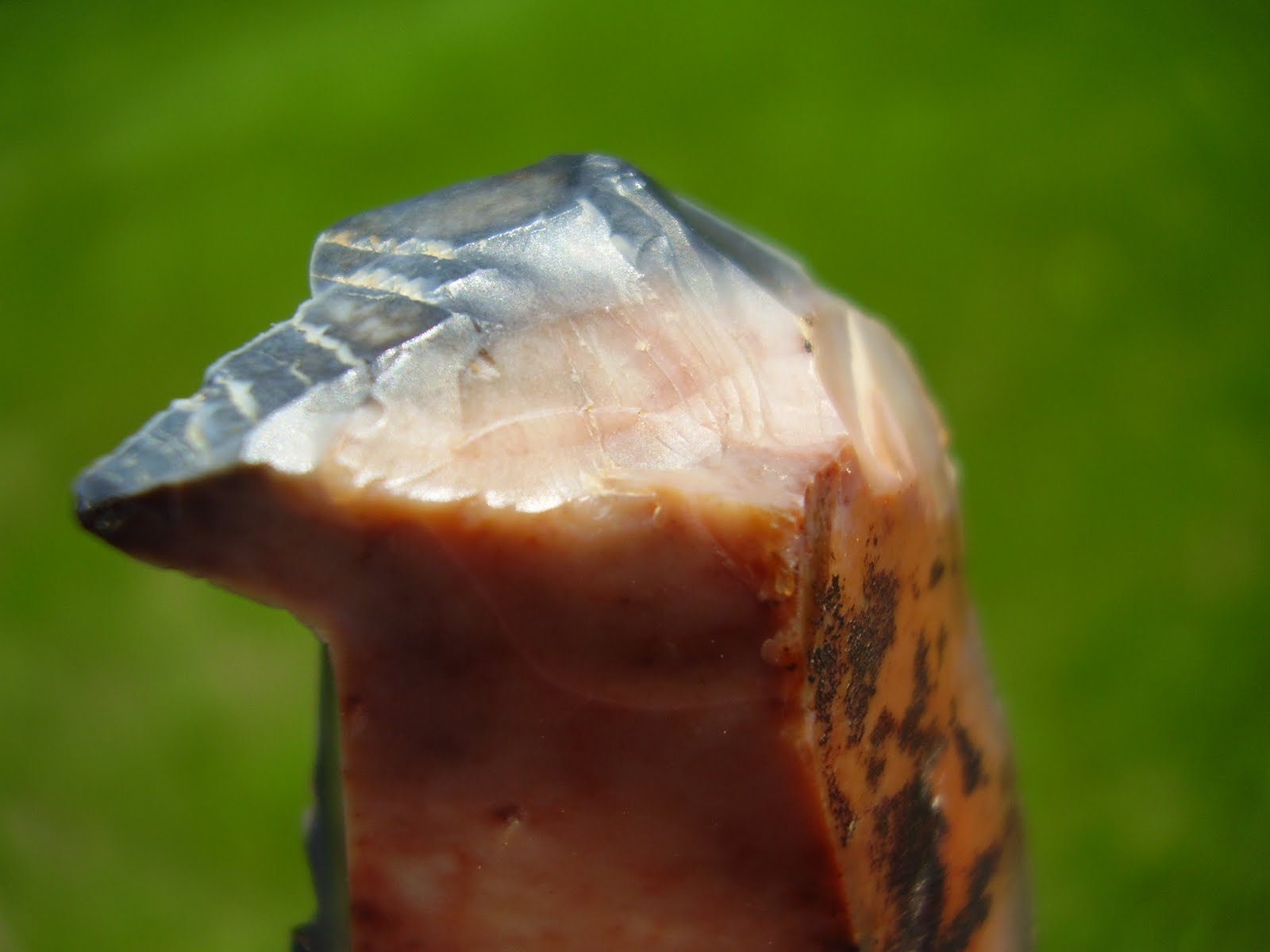
Close up of beaked "bird head" with flint work details.
(click photo to expand view)
This piece may be interpreted as a unified male and female bird where the female side is represented in darker flint, with eggs.  The male side is the pink flint, symbolic of female birds often being drab colored compared to their male counterparts.
The artifact and symbolism here are similar to finds at Boukoul, Netherlands, of archaeologist Jan van Es. Please see links at bottom of the portablerockart.com page for Jan van Es' web site.  Mr. van Es has described the egg, the bird and the pregnant woman as related icons in Pleistocene portable rock art motifs of Europe.  One of the eggs in the nest here is also the woman's belly and the other is her ovate thigh.