Denisovan Ancestry in East Eurasian and Native American Populations

Showing posts sorted by relevance for query boggs. Sort by date Show all posts

19 January 2015

"Topplehead" anthropomorphic PAC-MAN like stone stands upright in a perfectly precarious position and may be symbolic of a breaching whale

Dennis Boggs find near Boardman, Oregon, identified as an anthropomorphic head sculpture by Dennis in this iteration of a typology he identified in his collection.

Profile view of anthropomorphic head sculpture with scale


In this short video, the stone topples over after a puff of air is applied from an off-camera air can, demonstrating the tolerances to which it is balance-engineered.

-Interpretation of the "engineered to balance precariously" aspect by Ken Johnston, curator of the Boggs collection.  The stone can balance and topple over with the slightest movement or vibration or force applied to it as in the example of the air puff here.

-This is a PAC-MAN like anthropomorphic stone engineered to the tipping point. The PAC-MAN stone sculptures have been identified by several North American amatuer archaeologists in addition to Dennis Boggs.

-Prepared tripod base allows forward roll of stone

-Large, sculpted "eye" area on one side

-Open mouth anthropomorphic imagery, as in a shout or laugh. Possible breaching whale imagery.

-Similar to other PAC-MAN like stones identified by Dennis Boggs in the Columbia River Valley.

-Similar to a stone identified as a balanced laughing stone figure or "Bobblehead" from the Boggs collection. The bases on the two sculptures have both been engineered in the same way.


Profile views of the PAC-MAN like anthropomorphic balancing stone. Could it have been a novelty or a toy? Or an earthquake early warning detector?

My hypothesis is that this object represents a whale figure which has been given a smiling human quality and that it stands and falls over in a symbolic demonstration of the whale breaching and smacking the water. To make the stone topple, the puff of air from the air can must be applied to the approximate area of the whale figure's "blow hole."

Another Oregon whale sculpture has already been described from the Boggs collection.


Please note the anthropomorphic smiling quality on the face of this breaching humpback whale off the Pacific North American coast.  Compare the "smiles" of the whale and the whale sculpture. This human-like quality in the gigantic animal was realized in the manufacture of this Oregon portable rock art sculpture.

"Human head mixed to animal head" is a primary sculpture motif of the Lower and Middle Paleolithic according to Pietro Gaietto:

27 November 2012

Dennis Boggs collection, Oregon, includes this micro-sculpted pebble figure of a face with a featured inclusion as a sparkling eye

 Microart sculpted face on a pebble. 
The Dennis Boggs collection, Columbia River at Irrigon, Oregon
Pebble measures 3.5cm by 5cm in this view. The worked aspect, top of eye to bottom of mouth, is within 19mm/5cm

The left eye of the figure has some very small exposed crystals on the surface of the stone which reflect the direct sun like little sparkling stars. Unfortunately, my attempts to capture them with the camera were not successful. The stone comprising the left eye area does not have any sparkling attributes. This figure stone may well be an example of the "one eye open, one eye closed or missing" motif seen in world portable rock art as described at originsnet.org, and discovered by untold numbers of people from coast-to-coast in North America and in Europe. This is a meme originating in Lower Palaeolithic times, ca. 500,000-200,000 years before present, according to originsnet.org. Its presence calls for study of the Columbia River valley in Oregon and Washington for more archaeological evidence of humans carrying this meme into America at an, as of now, unknown time.

On close personal inspection at 10x lighted magnification through a Bausch and Lomb scope, I can recognize the eyes and under brow area as being humanly worked. One might think the mouth is a natural part of the stone which was exploited by the artist but I have seen enough of these "gashes" made on suspected art objects in the correct place (see the eyes on the figure "The Trickster" also found by Boggs) that I believe this is an intentional removal of stone material using a technique which was known to the early artists.

Find by Dennis Boggs at Irrigon, Oregon, along the Columbia River and in the context of other portable rock art which has been featured on this blog. (Search BOGGS).


View of the artifact to highlight two worn surfaces on the back which intersect at largely a right angle. The angle allows one to easily hold the head in the upright position in the finger tips as if to "experience the face and crystals" for oneself from the optimal viewing angle.

Only when viewing the artifact at an angle to see the face in its optimal position does the piece take on an overall egg-shaped appearance. At no other viewing angle does the pebble have any kind of an egg shape.

Thank you Dennis Boggs for sharing your 50 years of experience "looking at the rocks" along the Columbia!

-kbj

23 January 2012

Dennis Boggs of Oregon has identified pattern of Simian-looking faces on pebbles and pebble artifacts in the Columbia River valley

Dennis Boggs of Oregon has identified a pattern of simian-looking faces on pebbles and pebble artifacts in the Columbia River valley

Manuports and artifacts resembling ape faces are found in concentration below the higher elevations along the Columbia River near Irrigon, Oregon, according to Dennis Boggs. (You may perform a site search on "Boggs" to see additional posts of objects found by Dennis Boggs.)  Face-looking pebbles may be found almost anywhere, but the concentrations and types Dennis has collected over almost 50 years suggest more than natural coincidence. 

This is the back side of the face view.  Many of the face-looking pebbles have a divot on the back, as seen in the center of the pebble in this view, which facilitates stabilized handling with the fingers. 

Pebble shown with scale.  It appears there could have work on the eyes and nose and the divot on the rear, but I do not have the microscopic expertise to evaluate this.  The mouth line appears all natural and not altered.


-kbj

18 February 2011

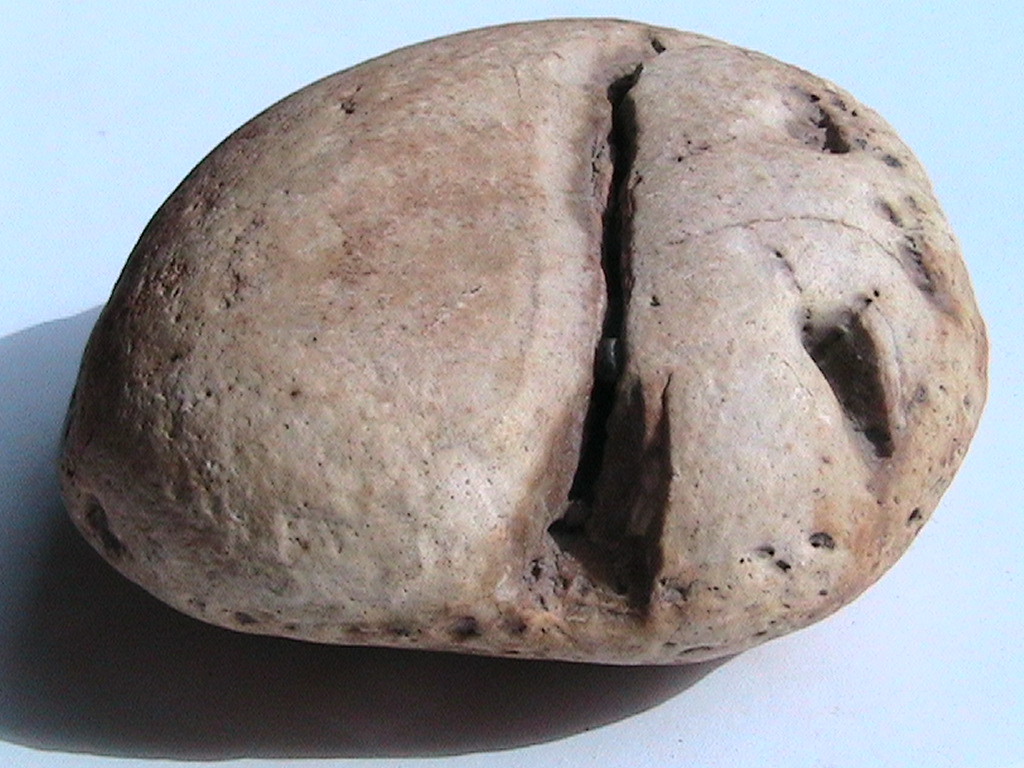
The Trickster

The Trickster

Mr. Dennis Boggs of Irrigon, Oregon, has been collecting suspected crude tools and figure stones for fifty years on the valley floor above the Columbia River and below desired locations on mountain terraces to camp, observe migrating animals, etc. 

This example was examined under 10x lighted magnification and there appears to be intended work on both eyes and the mouth.  The stone was likely pre-historically found to be suggestive (the crack itself of the mouth looks natural) and then was “rectified” to complete it to the desired end form of the artist.  The entire length of the lower “lip” has been worked to turn the harsh edge of the crack into a more a more smooth, natural one.  This gives the upper lip an appearance of projecting slightly beyond the lower lip.  The smoothing of the lower lip cut another angled surface, like taking a 90 degree edge from face into mouth crack and topping it off with a 45 degree slope.  This slope has been worked but it has also been heavilly rolled (weathered, tumbled in abrasive soils, worn away somewhat) so it looks more rounded today than a 45 degree angle upon rectification.

Both corners of the mouth were expanded with stone modification to represent 'smirks.' The eye on screen left looks to be human-expanded  from a smaller natural indent. The eye on screen right may be wholly manufactured by a chisel type instrument.  Perhaps a couple of small pebbles may have been inserted in mouth crack to represent teeth but they could have been naturally stuck in the crack due to erosive wear.  What could be interpreted as a small “tear” is leaving the inside corner of the eye on screen left. He looks to be laughing ‘till he cries.   
In the photo at left, a lighter band of stone along the lower lip area shows where material was removed to alter the natural crack.  There are two vertical lines between the eyes perhaps etched to represent a nose.  The visual "flow" of the nose matches the "flow" of the face toward the larger grinning side.

In the Boggs Collection, there are also items I might not find in Ohio or from my mostly eastern U.S.A. contacts.  Sperm whale, grey whale, killer whale and porpoise are represented in the Boggs collection.  One anthromorphic and one zoomorphic figure stone artifact will be posted in coming months where in addition to photos, there will also be demonstration of these amazing "joke" or "entertainment" figures in moving video on YouTube.  
Thank you Dennis Boggs for submitting such an emotive human face figure stone and for making your collection of thousands of suspected artifacts available for close examination and study to us in Ohio and elsewhere.  We will be busy for a very long time.  More of the Boggs collection will be seen here, as it demonstrates themes and artifact types similar to finds at sites in the mid-west and eastern U.S.A., Europe and Asia. 
The view here is along the  mouth crack from left side of face (photo bottom) to right side (photo top).  The light stone band along the lower lip is where stone was removed to open the mouth up a bit.  A good shot of the dimple area modifiction here, or an expansion of the left end of the mouth (photo bottom).

Back side of the artifact.  Although it appears it could  present a second face, examination did not reveal any clear human work.  A face on the reverse of a relatively explicit face image should be considered for artifactuality.  However, without evidence of human modification here, it remains an unanswered question. It may be that analysis using magnification beyond the 10x I commonly use, along with the interpretive expertise to use that technology on stone, could shed more light on this.  -kbj

16 April 2014

One eye open, other eye shut, feline and human faces in micro-art on a pebble from the Columbia River valley

Micro-art feline face

Isolated image from the pebble of a one eye open, other eye shut or missing feline face (with tongue out) interpreted by Ken Johnston. The right eye is a small cluster of quartz crystals and the left eye contains some empty space, affecting the known one eye open art motif. Figure stone find by Dennis Boggs at Irrigon, Oregon.

Dennis Boggs find, Irrigon, Oregon

Here I interpret a human head with one eye open, other eye shut or missing representation on the same pebble. There are two nostril holes worked on this face to add the symbolic breath of life to the figure. There may a recognition or representation of the two hemispheres of the human brain on this figure.

One-eyed human and feline figures have been described from Eurasia as well as North America on this blog. Jan van Es of Roermond, The Netherlands, taught me what to look for in Paleolithic micro pebble art and this North American figure is similar to those van Es has shared from Lower and Middle Paleolithic archaeological sites he is familiar with from northern Europe.

The typical context for Mr. Boggs' finds include worked pebbles like at left and center, as well as suspected manuported exotic stones like at right. A number of stones appear worked to access quartz crystal inclusions and will be featured in a future posting here.

Left is the figure stone featured in this article. Right is another Dennis Boggs human head figure stone featured earlier on this blog. One may see the similarity in the stone working technique/technology used in the manufacture of the eye elements on both figures.

Feline figure as the stone fits most comfortably in the hand, as if the cat is reclining on outstretched front legs. The "front legs" feature is very smoothed as if worn by rubbing and accomodates the thumb perfectly when held like this.

Feline face looking out from the "cave" created by the human hand when it is held as a "rubbing stone."

African lion with tongue out like feline on the figure stone (left eye illustrated as missing)

28 November 2011

Dennis Boggs' finds along Columbia River include artifacts and manuports featuring imagery such as this head

Found by Dennis Boggs, Boardman, Oregon

This human head in left profile view figure stone was found by Dennis Boggs, Boardman, Oregon, within 2km of the current Columbia River at Irrigon, OR.  It is 8cm x 8cm x3cm size.  For nearly 50 years, Dennis has been collecting suspected humanly worked stones from below possible cultural sites very close to the Columbia. It seems most all of the stone material at his sites has been manuported there, so it is an amazing collection of lithic material, almost a "prehistoric rock collection." For geographic context, the "Kennewick Man" skeletal remains were found about 90 km upriver from the find location of this head profile.  Dennis shipped this piece to me almost a year ago, along with many others already, and to be, seen on this blog, for me to photograph. It has somehow slipped out of my control and into my general collection of some several thousand suspected crude art and tool pieces. I will be taking time over the winter to search for it. I remember when I saw it in person, the three dimensions of the jaw line and the pinkish lips made it quite impressive. Thanks to Dennis Boggs for this photo and I'll be posting updated photos once I am able to study this manuport or artifact.

-kbj

21 March 2013

Rock suspected of being a Stone Age curated manuport may have been worked to enhance perceived facial features in the random surface pattern

Dennis Boggs find, Columbia River valley foothills, Irrigon, Oregon 

Collector Dennis Boggs recognizes certain stone material as "exotic" to his locale and in unnatural concentrations and flags it for closer inspection for evidence of human modification.


Side view

Dennis Boggs obsidian tool, Columbia River valley. Mode I Oldowan tool forms like this are plentiful but not accounted for by American archaeologists.

Obsidian hydration dating on this fracture might be possible.

Dennis Boggs find, Columbia River valley, Irrigon, Oregon. Levallois point, American style. I have identified Middle-Paleolithic portable rock art motifs in Dennis' collection. Most of the tools found near or with the art are cutters, choppers, scrapers and pounders. A point like this is rare.

-kbj

04 August 2013

Small translucent human head pebble figure from Oregon shares iconography with larger Missouri and The Netherlands examples

Dennis Boggs find, Irrigon, Oregon

This is a worked representation of a human head profile looking left with an elongated face and nose. There is no apparent tool use for this object and the attention to detail in the micro-sculpting of this pebble, its likeness to an anthropomorphic image and its likeness to other suspected sculptures suggests the work was done to realize the image. Mr. Boggs has collected suspected tools and art objects from along the Columbia River at Irrigon, Oregon for almost 50 years and generously gifted his finds to this blog so they could shared with a wide audience. (enter BOGGS in the blog search box at right for a list of other postings related to this collection)

From Jan van Es, The Netherlands, a long-faced human head rock which shares iconographic similarity with the Oregon sculpted pebble

The Oregon pebble face is translucent and has red inclusions in the amber orange color 

The pebble has been split to open up a side for the sculpture. (LEFT) The cortex on the left side and the worked surface on the right side. (RIGHT) the raw stone surface or cortex

Cortex view with CM scale (approx. 4cm long)

Dennis Boggs' Oregon pebble artifact on left, Keith Stamper Missouri artifact with similar iconography on right was found in context of Levallois technique tools. Jan van Es said he recognizes the Keith Stamper stone as strikingly similar to typical early Neanderthaler art he has studied dated 300,000 to 150,000 years before present.

Here is a markup on the Oregon artifact illustrating the interpreted facial features, white eye, black base of nose and red mouth. The eye is small bit of flint in bas relief which was retained in the "correct" position by the skilled rock artist here. (Click photos to expand. Toggle with your mouse from last to first photos in the series to see the illustration of the intentional flint work to execute the anthropomorphic facial image.)

-kbj