Denisovan Ancestry in East Eurasian and Native American Populations

Showing posts with label smile. Show all posts

07 October 2013

Little mammoth figure with human face icon in bas relief on its side

Little mammoth figure with human face in bas relief on its side
Find by archaeologist Jan van Es, The Netherlands
 
The human/mammoth combination seen in Hans Gram's sculpture featured in the prior posting and in other sculptures featured on this blog is also seen here on this small pebble with a mammoth form including eye, with a simple human face icon on its side. The mammoth is facing right and the human face is looking straight-on, perhaps smiling. The photo at right shows human stone removal to define the oval-shaped human head.

American paleolithic sculpture example of a smiling human face on the side of a mammoth
 
This North Carolina mammoth shaped sculpture (in profile facing left) identified by Buzzy Boles was interpreted in an earlier posting on this blog as having a carved smiling human face mask, a bison head looking right and a lion face in the lower left as illustrated here.

24 June 2011

Amateur archaeologists independently identify Oregon and Tennessee face-like icons exhibiting similar left-oriented, smiling, look

Sherry Hill find, Carter County, Tennessee

Dennis Boggs collection, Irrigon, Oregon
artifact is pictured on a centimeter(cm) grid for scale
In the first example, the lip begins just slightly right of the vertical center line of the face.  Most of the smiling lip line is oriented toward the left side of the face (right side of photo).  In the second example, the entire lip line is seen in this photo, all of it on the left side of this face stone. The suspected artifacts are about 6cm and 5cm in length respectively.

18 February 2011

The Trickster

The Trickster

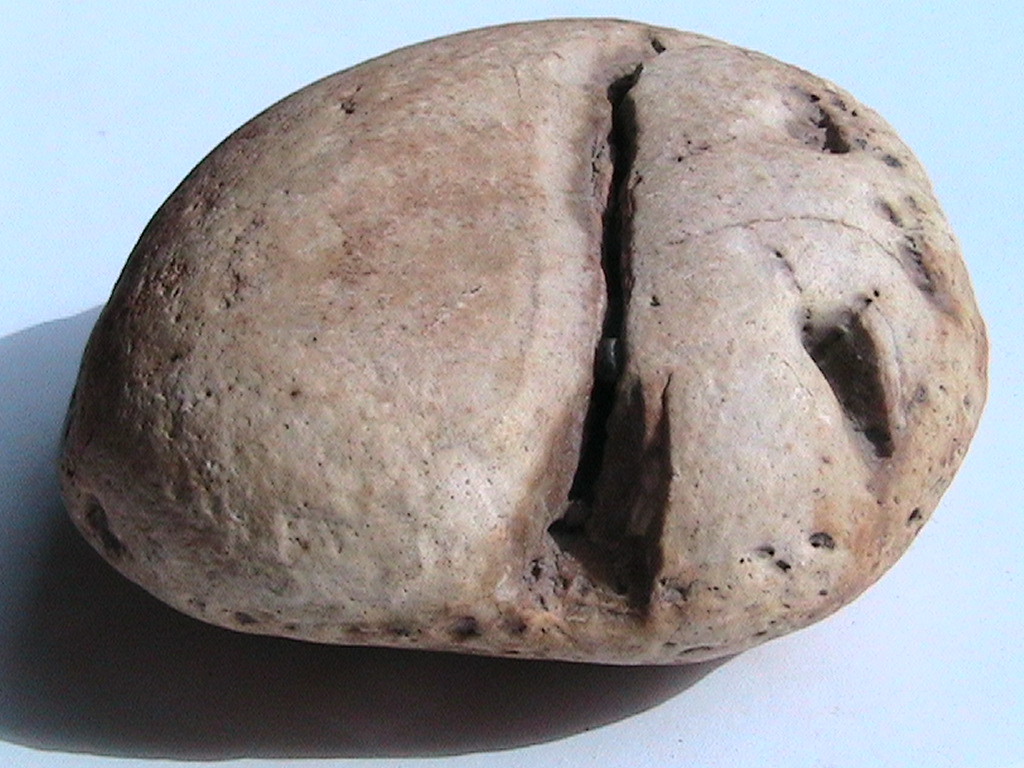
Mr. Dennis Boggs of Irrigon, Oregon, has been collecting suspected crude tools and figure stones for fifty years on the valley floor above the Columbia River and below desired locations on mountain terraces to camp, observe migrating animals, etc. 

This example was examined under 10x lighted magnification and there appears to be intended work on both eyes and the mouth.  The stone was likely pre-historically found to be suggestive (the crack itself of the mouth looks natural) and then was “rectified” to complete it to the desired end form of the artist.  The entire length of the lower “lip” has been worked to turn the harsh edge of the crack into a more a more smooth, natural one.  This gives the upper lip an appearance of projecting slightly beyond the lower lip.  The smoothing of the lower lip cut another angled surface, like taking a 90 degree edge from face into mouth crack and topping it off with a 45 degree slope.  This slope has been worked but it has also been heavilly rolled (weathered, tumbled in abrasive soils, worn away somewhat) so it looks more rounded today than a 45 degree angle upon rectification.

Both corners of the mouth were expanded with stone modification to represent 'smirks.' The eye on screen left looks to be human-expanded  from a smaller natural indent. The eye on screen right may be wholly manufactured by a chisel type instrument.  Perhaps a couple of small pebbles may have been inserted in mouth crack to represent teeth but they could have been naturally stuck in the crack due to erosive wear.  What could be interpreted as a small “tear” is leaving the inside corner of the eye on screen left. He looks to be laughing ‘till he cries.   
In the photo at left, a lighter band of stone along the lower lip area shows where material was removed to alter the natural crack.  There are two vertical lines between the eyes perhaps etched to represent a nose.  The visual "flow" of the nose matches the "flow" of the face toward the larger grinning side.

In the Boggs Collection, there are also items I might not find in Ohio or from my mostly eastern U.S.A. contacts.  Sperm whale, grey whale, killer whale and porpoise are represented in the Boggs collection.  One anthromorphic and one zoomorphic figure stone artifact will be posted in coming months where in addition to photos, there will also be demonstration of these amazing "joke" or "entertainment" figures in moving video on YouTube.  
Thank you Dennis Boggs for submitting such an emotive human face figure stone and for making your collection of thousands of suspected artifacts available for close examination and study to us in Ohio and elsewhere.  We will be busy for a very long time.  More of the Boggs collection will be seen here, as it demonstrates themes and artifact types similar to finds at sites in the mid-west and eastern U.S.A., Europe and Asia. 
The view here is along the  mouth crack from left side of face (photo bottom) to right side (photo top).  The light stone band along the lower lip is where stone was removed to open the mouth up a bit.  A good shot of the dimple area modifiction here, or an expansion of the left end of the mouth (photo bottom).

Back side of the artifact.  Although it appears it could  present a second face, examination did not reveal any clear human work.  A face on the reverse of a relatively explicit face image should be considered for artifactuality.  However, without evidence of human modification here, it remains an unanswered question. It may be that analysis using magnification beyond the 10x I commonly use, along with the interpretive expertise to use that technology on stone, could shed more light on this.  -kbj

13 February 2011

Cartoon-like human head right profile

Human head facing right, with a grin and a dimple

Allen Deibel of Canfield, Ohio, U.S.A., identifies this worked pebble as "almost comical."  The artifact seems foretelling of the illustrations of early-mid 20th century humorist, illustrator and cartoonist James Thurber of The New Yorker and The Saturday Evening Post.  It is known that prehistoric peoples used cartoon-like exaggeration to convey more meaning than otherwise possible in the often small and rounded medium of stone.  For cave art examples, please see figure 4.24 in Barbara Olins Alpert's book The Creative Ice Age Brain, including the Roc Saint Cirq caricature head and more.

If one moves viewing angle slightly and shifts visual attention from the cartoon face to translate the "dimple" and the "base of nose circle" as eyes, a feline-like visage emerges where the feline and the human are sharing the same mouth and chin, feline facing straight on toward viewer on a vertical pole orientation of 5 and 11 o'clock.  Allen has identified significant use of feline motifs, in particular, in the Mahoning River valley and surrounds and has amassed a collection of hundreds of pierre-figures from north-east Ohio.

Deibel has composed a fine collection of line drawings of his artifact interpretations.  These line drawings will be of great assistance to anyone new to the portable rock art subject. If you are looking at artifacts here and thinking "I don't see it," the drawings will illustrate how the visages are interpreted by Allen and others.  The images are often comprised of combinations of color and relief in the stone material and are sometimes difficult to capture and communicate in photos.

http://s813.photobucket.com/albums/zz56/kenbjohn/Diebel%20Cat%20Drawings/

He has also perfected the technique of figure stone presentation using chopsticks, a fine example of this innovation seen above.  Work of James Thurber below.


"What's Come Over You Since Friday, Miss Schemke?"

-kbj