Denisovan Ancestry in East Eurasian and Native American Populations

18 November 2012

Flint flake notched beyond utilitarian need suggests possible prehistoric intent to make a human head effigy


Jimmy writes, "Yes, during a prospection near the Neolithic flint mines of Rijckholt, (a very important flint mine for the region), I found at the surface, this notched flake, a little bit "over-notched" perhaps... Maybe this was made on purpose to get a profile of a head?"

-kbj

15 November 2012

Artist, now amateur archaeologist, discovers portable rock art cultural remnants on the desert surface at Prescott, Arizona

A bird form (and possible scraper tool), from Nadia Clark, Prescott, Arizona

Side 2, sculpture standing upright on its own

Nadia demonstrates how an edge suitable for scraping or chopping is presented when the bird sculpture is held optimally in the hand

Heavy duty rhomboid burin/borers discovered by Nadia Clark in association with her portable rock art finds. These tool forms have been identified by several amateur archaeologists and will prove to be associated with early art and tool makers in the Americas. They do not seem to have been described by American archaeology but will be shown in the near future on this blog from several sites along with the art associated with the rhomboids. Similar rhomboid tools have been associated with the chopper/chopping tool tradition of Europe.

Former cultural sites are exposed at the surface and Nadia has identified concentrations of likely iconic rock material

Careful examination of rocks on the desert floor at Prescott, Arizona, reveals rhomboid tool forms and classic figure stones

-kbj

12 November 2012

West Virginia rock panel relief carving may depict an action scene of a human fleeing a lion biting the neck of a bear

West Virginia rock panel relief carving may depict an action scene of a human fleeing a lion biting the neck of a bear
Mike Ellis find and photo from near Charleston, West Virginia. Photo courtesy of Alan Day, the Day's Knob web site, where Alan presents some more of Mr. Ellis' finds, among figure stones from the Day's Knob site (#33GU218) and from 17 states with more to come.

Ken Johnston interpretation and illustration of the rock art action scene. The lion's mouth is represented by the red line. The artist presents the human's left body profile, the lion's head right profile and the bear head viewed straight on from the front. (click photo to expand and toggle between clean photo and the illustration).

-kbj

09 November 2012

Similar rock forms identified by three amateur archaeologists suggest prehistoric propensity to collect laughing stone "hand puppet" mimetoliths

Laughing stone #4 on this blog

Mike Raver find, Zanesville, Muskingum County, Ohio. Found in the context of tools and other portable rock art pieces, some of which have been published on this blog.  Mike's blog is here.


Dennis Boggs finds, Irrigon, Oregon flanking Sherry's "Kermit the frog" rock in the middle. The rock on the left is a bobble-head which will rock as if laughing when set into motion by a slight push.

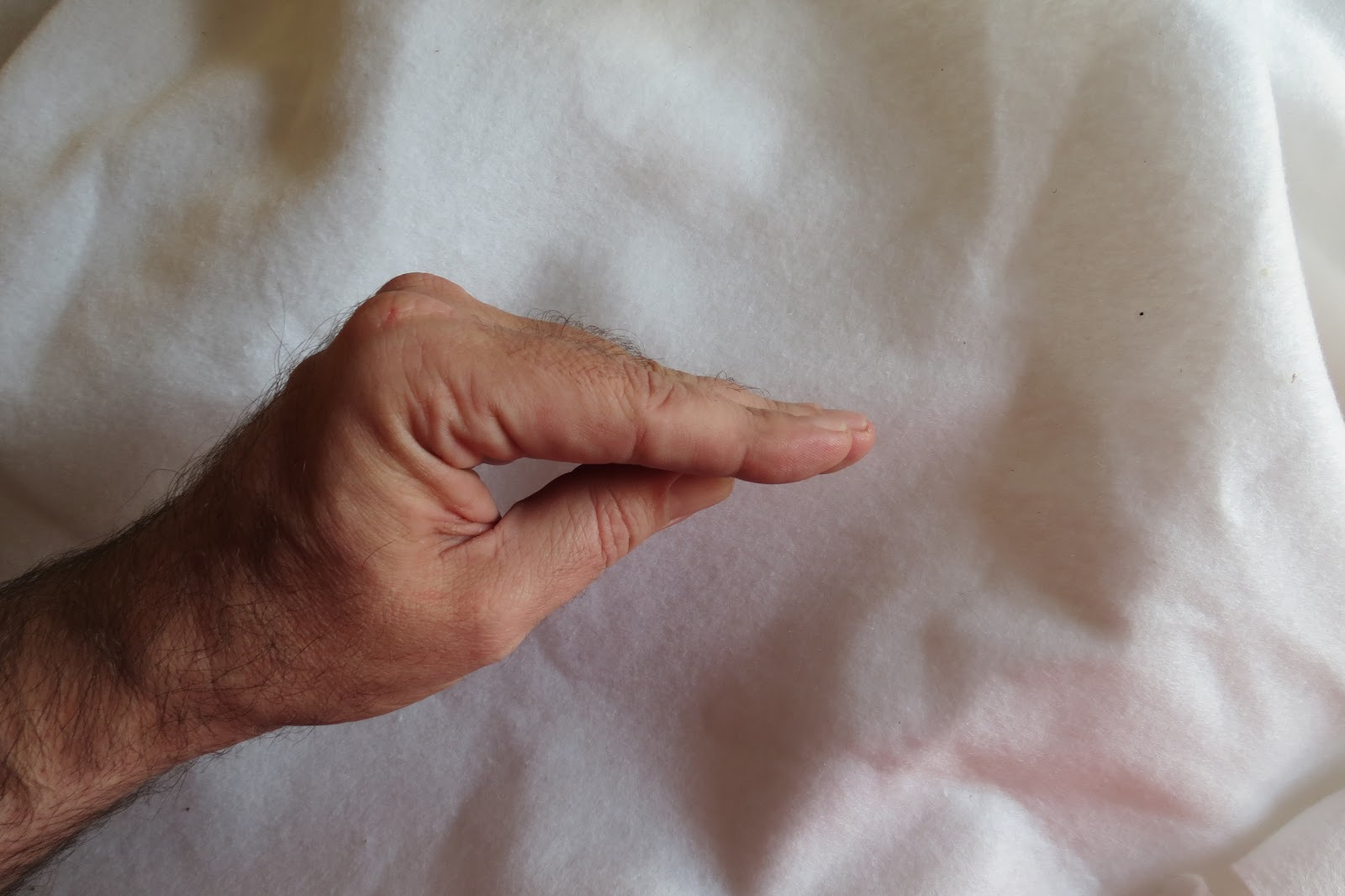
Laughing stone, Zanesville, Ohio, has a mouth angle similar to the maximum angle which can be achieved by the human hand in "laughing hand puppet" position as seen in the photo below.


The head of this anthropomorphic "stick figure" form in Brazil cave rock art resembles the outline of the shadow of the human hand puppet form. Perhaps this kind of hand puppet was used as a prop or medium in story telling which was recognized and collected when natural rocks with a similar form were discovered.

-kbj

08 November 2012

Mike Raver find at Zanesville, Ohio, may be example of form documented by Italian prehistoric sculpture scholar Pietro Gaietto

A zooanthropomorphic sculpted figure identified by Mike Raver, from Zanesville, Ohio, in Muskingum County.

Author and rock art investigator Pietro Gaietto of Italy presents this suspected sculpture on his web site. The Ohio example may support Gaietto's idea that this find was an intended figure.

Mr. Gaietto writes on his web site:
"FIG. 3 Zooantropomorphic lithic sculpture found by ISAIE DHARVENT in 1902 or previously.
It is an old photography, in which cannot see the parts worked on the nodule of silex. Perhaps it is damaged from alluvial tumbling. The representation, in the interpretation of Dharvent, was the head of a monkey; my interpretation is different: the profile of the head has jaw and human forehead, while the mouth is of animal, therefore is an artistic hybrid.
Measures: probably 6 cm. height.
Origin: probably Center - North of France.
Cultural attribution: probably middle Acheulean.
In this photography the working traces are not looked at, do not look at the back; moreover the mouth is atypical, perhaps influenced from the shape of the nodule of silex, therefore, it is not possible to establish with certainty the authenticity."

A link to Gaietto's book (in Italian language) is in the right screen panel "Anthromoporphic Paleolithic Sculpture"

 Side 2 of the Ohio human/animal sculpture found by Mike Raver

An Oregon anthropomorphic form identified by Dennis Boggs, Irrigon, Oregon, and the subject of an earlier posting. It also compares favorably to a Gaietto described sculpture.

-kbj

07 November 2012

Flint handaxe may depict therianthropy or even human to animal shamanic transformation process

Human head looking left with glassy inclusion serving as mouth line

This handaxe from Flint Ridge, Licking County, Ohio, incorporates a human head profile with chin prominence. The person seems to have a headdress of some kind. While studying this piece I noticed it could well depict an animal head on top of, and combined with, the human head.

Illustration of carved circular animal eye, hypothetical location of human eye, and red line indicating stone inclusion incorporated as the mouth line of the face.

A famous Ohio Hopewell tradition portable rock art piece known as the Wray Figurine was found 10 miles away from this flint in the mounds of the Newark, Ohio, earthworks, the largest geometric earthworks in the world and a nominated UNESCO World Heritage Site.

Here is an illustration of what could be interpreted as an animal head and neck on top of the human head. (click photos to expand).

The Wray figurine depicting a Hopewell shaman in the act of transforming into a bear.  Height of figurine, 16 centimeters.  Recovered from one of the principal burial mounds at the Newark Earthworks (Dragoo and Wray 1964).


Side 2 with scale. The top edge shown here is the blade of a handaxe/chopper. The flint stands upright  with the facial profile looking downward.


-kbj

04 November 2012

Stone birds are well documented from the SDM Site, Kent County, Michigan

A stone owl figure from the SDM Site, Solon Township, Kent County, Michigan (sound!)
Courtesy Dennis J. Moore


This stone owl weighs 81 lbs. and is 18" tall. Peck parks represent spots on the owl's breast. It is similar to other stone owl forms identified in a context of portable rock art bird figures. Like my Buckeye Lake finds, the SDM Site which produced the owl is located in a geographic context of glacial kettle lakes.

Dennis' father, Edward R. Moore, is the first (1977) person to have described the "one eye open/one eye closed/missing" portable rock art motif in North America, based on his findings at the SDM site. He was unaware others such as Germany's Walther Matthes had described it in Europe in the late 1950's. Some of the SDM Site bird figures resemble those identified by Ursel Benekendorff of Germany.

Side 2 of the owl

Markings on some of the SDM site pieces are described by Mr. Moore as plow marks, but in the example above the marks are parallel and perpendicular incised lines, deliberate of the human hand, and may be a part of the art piece. Many good examples of chert and coarse stone birds are available at the SDM web site (sound!) and a Field Guide is for sale.

-kbj

01 November 2012

Flint effigy discovered

Flint effigy discovered
Human head looking left, find by Ken Johnston, Licking County, Ohio

This artifact was found relatively close to a bird figure/tool with a similar knife incorporated into the crest of the bird's head (see prior posting, Oct. 25), much like the one incorporated into the human forehead here. This supports the idea that this is an intended human head icon with a tool element on the peak of its head.

Knife and scraper tool elements are labeled here. The artifact is designed to fit the hand comfortably while the knife and scraper surfaces are being used. The rounding of the side of the face here is the bulb of force from the creation of the flake.
Side 2 with scale

Side 2

Flint head effigy looking left. Under the nose, the chin and the throat area of the person is seen in the whiter crystal material.  

-kbj

25 October 2012

A bird in the hand

A bird in the hand

From Flint Ridge, Licking County, Ohio. Flint with this kind of coloration is like a canvas for the prehistoric artist and the rock material which includes crystals seems to have been highly valued. This artifact has bird-like visual properties and has a blade with suspected use-wear.  It is worth beholding as a beautiful example of the synthesis of art and tool.


The crystal-throated bird is a fine piece of rock art. Maybe the crystals are symbolic of the bird's song.


Side 2 with scale

The crystal beak of the bird could have served the functional purpose of being a leading edge, a kind of ripper, preceding the excurvate knife blade or being used on its own if wanted.

-kbj

Gem hunter's "Just a volcanic rock" from Topaz Mountain, Utah, worthy of expert evaluation of artifactuality

Mike Youtz find, Topaz Mountain, Utah

At the Skull-a-day.com web site, Mike Youtz writes

"Found this interesting Rhyolite rock while in Utah back in May 2011. We were wrapping up a two-week geology field class when we decided to visit Topaz Mountain in western Utah to do a little gem hunting. Instead I found this! Way cooler than a topaz in my opinion. At first glance I thought it was the petrified skull of some critter but nope, it’s just a volcanic rock. Enjoy!"

Any suspected portable rock art find outside of an archaeological context has a diminished value to our understanding of what transpired in the past. The find by Mike here is a good example of an object which is at least a mimetolith which could have been recognized and appreciated in prehistory, and possibly an artifact if it was altered in any way by the human hand.

Finds like this can be used to identify possible archaeological sites of significance where tools and other art objects might be found. An object with strong visual properties such as this should trigger an evaluation by archaeological science of the object itself and the context from where it came.

In my experience however, professional archaeologists would immediately make the same assessment as the gem hunter here did, and dismiss this jawless stone skull form as wholly a product of chaos, having no potential significance to a greater understanding of our human past. Sadly, these are opportunities lost for development of archaeological knowledge. Anomalies such as this skull deserve careful evaluation, not immediate dismissal. Only when archaeologists develop more specialized knowledge than the general public do they have any credibility in matters of portable rock art.

Some reasons why this object is a candidate for archaeological investigation:

1) a rounded aspect to the top of the skull which may be shaped by controlled flake removal
2) a larger left eye socket is in accordance with the known "one eye open, one eye closed/or missing" portable rock art motif seen in the Middle Paleolithic and seen in other American portable rock art objects of unknown age
3) possible flake removal under the left eye to shape the cheek
4) a symmetrical aspect to the stone which is aesthetically appealing

-kbj

21 October 2012

Five flint artifacts with distinct bird forms, Licking County, Ohio

 Five flint artifacts with distinct bird forms, Licking County, Ohio

Side 1

Side 2


Side 1 and 2 of standing flake with translucent aspect

Side 1 standing upright and side 2 from above

 Side 1 and 2 of standing bird head figure

Side 1 and 2 of beaked bird head figure
 (click photos to expand)


-kbj