Denisovan Ancestry in East Eurasian and Native American Populations

Showing posts sorted by relevance for query bird in flight. Sort by date Show all posts

07 February 2012

"Bird in flight" from a Flint Ridge, Ohio, quarry known to produce art

Retouched object invokes "bird in flight" imagery and is made of Flint Ridge flint, Ohio's official state gemstone

This retouched object was found at Flint Ridge, Glenford, Ohio, in the Spring of 2011.  As the Canada geese and other birds are now migrating over my lake side home in Hebron, Ohio, I was reminded of the imagery of birds in flight which may have been recognized in this piece, and then modified by carving techniques to complete the form.  It is possible certain pieces were recognized as potential animal or people forms during the tool manufacture process and then set aside or perhaps touched up a bit to complete the idea suggested by the natural form.  In this case, a thinner and crystalline part of the flint may have appeared as the thin neck of a bird pushing the head forward in flight.

(click photos to expand detail)


Hohle Fels famous bird in flight (Germany, Auriginacian era) was carved of mammoth ivory. Water birds seem to be very important throughout paleoart and we can only imagine the perishable (wooden) bird sculptures which have been lost to time.  This is one of the most famous pieces of art mobilier in the world. This carved sculpture is approximately 32,000 years old.


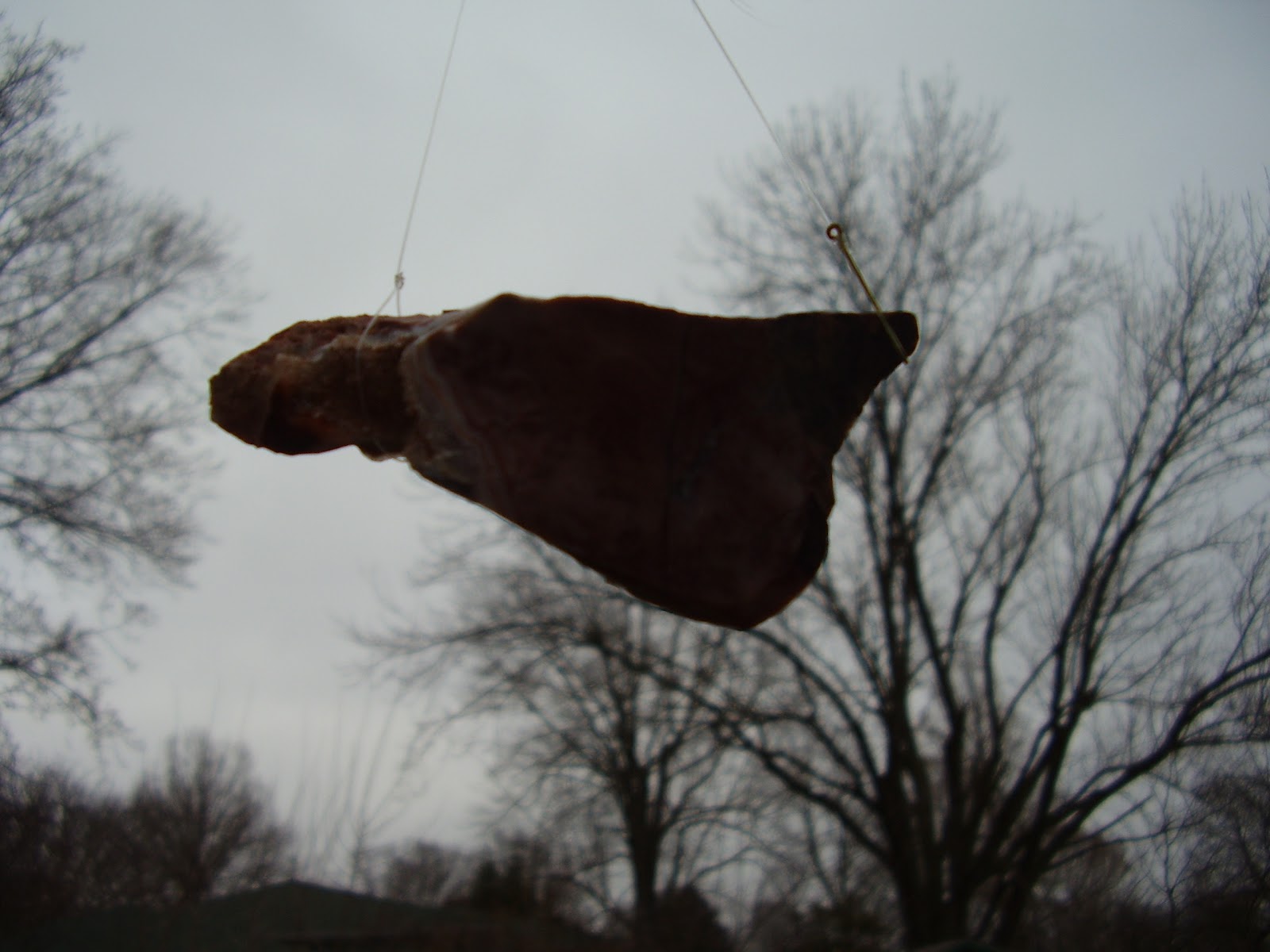
Flint Ridge, Ohio, is known as one of finest sources of chert in North America, combining workability, beauty and strength.  This "bird in flight" was found in the same quarry location as "Peter Cottontail" and the "Least Bittern," among other postings on this blog, which increases the possibility it could have been recognized and worked in prehistory in a larger cultural context.  There may have been some artists working at this quarry site or these could be the by-product of creative-minded workers recognizing visual potential and then maybe "doodling" animal forms in stone while they took a break from making tools.

-kbj

10 February 2012

Bird taking flight from nest with egg (expressed as bulb of percussion)

Bird taking flight from nest with egg (expressed as bulb of percussion)

This artifact was found among other figure stones at a site near Buckeye Lake, Ohio, which has produced more than a dozen suspected flint bird heads and other mostly bird sculpture forms. The site is mostly covered now by a paved rest area along Interstate-70. If this creation is accepted as a "bird in flight" as I think was intended by its maker, it may have been inspired by the bulb of percussion and ripple found in the piece of flint. It is as if the bird is taking off into flight and leaving an egg in the nest. (Click photo to expand detail.)

The bulb of percussion (symbolically perhaps an egg in the nest or sun in the sky) in the flint is circled in white, eye and mouth illustration added to the suspected flying bird for visual orientation

There is a remarkable similarity shared here with the head of the suspected flying bird in the prior posting which seems to reinforce the possibility they are both intended depictions of flying birds, perhaps made in "the same tradition." This artifact was found about 15km from the Flint Ridge site of the prior posting, but is made of Flint Ridge material as well.


-kbj

26 April 2014

"Birds in flight" from Arkansas, Ohio and the German Swabian Alps show a consistency of art forms despite geographic distance and different raw materials

 "Bird in flight" coarse stone figure identified by Jeff Vincent, Mammoth Springs, Arkansas

Hohle Fels (Hollow Rock), Germany archaeological site carved mammoth ivory "bird in flight" figure, ca. 33,000 to 31,000 BP. (Image has been flipped for a more direct comparison to the birds from Arkansas and Ohio)

"Bird in flight" flint figure, made of Vanport chert, Flint Ridge, Ohio, identified by Ken Johnston in an earlier posting on this blog

23 May 2012

Hoard #7 of 7: a sculpted flint and crystal owl, with a bird in flight depicted at its right eye and a still bird depicted at its beak

Buckeye Lake, Ohio, sculpture hoard #7 of 7 is a sculpted flint and crystal owl, with a bird in flight depicted at its right eye and a still bird depicted at its beak.


Ready to fly. View from reverse

Owl face. The head of the owl has been rounded off and shaped.The crystals have been worked to enhance the shape of the eyes and the beak. The artist recognized potential in the natural stone material and finished it off with final shaping. 


The bird in flight at right eye and the still bird at the beak may be seen here. (click photos to expand and compare)

 Markups of where the two other birds are depicted

The owl has built in hand holds. The two small arrows at left point to substantial grooves which accept the left hand index and middle fingers while the left hand holds a knob in the flint. The right arrow points to a smooth surface which fits perfectly on the open right hand to support the weight of the sculpture. It seems the owl was capable of being held or carried securely.

 "Whoo doesn't love Flint Ridge, Ohio?"

-kbj

09 July 2014

Missouri "bird in flight" stone figure compares favorably to two Arkansas figures, has human face images on posterior like other examples

"Bird in flight" stone figure identified by Stacy Dodd and Rod Weber, from The Old Route 66 Zoo site, 23JP1222, near Joplin, Missouri. 

Mammoth Spring, Arkansas, finds by Jeff Vincent featured already on this blog. The bird at left has a smiling human face on its tail. Other bird figures on this blog have smiling humans integrated into the head or tail.

There is a faint trace of a human face on the bird's tail feathers like in examples seen in the posting yesterday, July 8. Like other depictions in portable rock art, and particularly from The Old Route 66 Zoo site, there appear to be teeth in the human's mouth.

 Faint trace of a second smiling human face image on the bird's tail.

03 September 2015

Vanport chert sculpture depicts an owl with a quartz crystal bird at its beak and another bird figure sharing the owl's right eye

Flint Ridge, Ohio, bird sculpture stands upright on its tail
Ken Johnston find, Licking County, Ohio (10cm)

The raptor, presumably an owl, in other perspectives


Illustration series of another interpreted owl face with shaped bird in crystals at its beak

Crystal cavity in the stone worked into the left profile of a bird figure depicted at the owl's beak with its own beak pointing to the upper left. It has worked split tail feathers upon close inspection of the stone.


Illustration #1: Owl face with crystal bird shaped cavity outlined at its yellow marked beak. Its right eye is circled and the left eye is marked with a line. Illustration #2: 'Three birds in one view' with blue highlights and yellow beak added to the third bird form. The right eye of the owl is also the left eye of the blue bird. The blue bird has the crystal bird as it wing and tail.

Flint Ridge Ohio owl sculpture, September 2015

'Owl face' is a second very similar example from Licking County, Ohio

This owl sculpture in flint and quartz crystal was found as part of the Buckeye Lake Paleolithic Sculpture Hoard. It is depicting a perched or still bird at its beak and a bird in flight at its right eye.

The significance here is two flint and crystal owl sculptures both depicting two more birds on the owls' faces, one associated with the beak and the other associated with the right eye of the owls.

The find locations for the two owl sculptures are 11 miles apart, from Harbor Hills to Flint Ridge. The red line on the map crosses Interstate-70 and U.S. Route 40, The Old National Road. Buckeye Lake is about 25 miles east of downtown Columbus, Ohio.

13 January 2015

The lost "Lost Valley" site #36CU190 produced a wolf head sculpture with a human head joined on its neck among other diagnostic art pieces

The Lost Valley site, #36CU190, South Central Pennsylvania, Gary Yanonne and Jeffrey Kottmyer, 2003. Wolf head looking right and human head looking left joined to the back of its neck.

The archaeology establishment was not able to understand or process the information which was being provided by the dedicated amateurs of The Lost Valley project. In a review of the findings which are over 10 years old now, I see a site producing recognized portable rock art motifs. However, the land the site is situated upon has been sold and archaeological research has been abandoned.

It is indeed painful to read the narratives of Paul Raber, President, and Philip A. Perazio, Past President,The Society for Pennsylvania Archaeology, Inc. in their Newsletter Winter 2004-2005. It ironically becomes a demonstration of how the earliest archaeological sites in North America are squandered by persons who sit on dogmas from positions of authority and can't think outside of terms they already know. Their "Judge, Jury and Executioner" article in the newsletter ended the ability of the site owner to gain further academic or professional archaeological attention. A likely pre-Clovis site called Lost Valley was ripe for study fully 10 years ago but all its information is now in the lost valley of Archaeology officialdom. 

Illustration of interpretation by Gary Yannone, The Lost Valley project.


A classic paleolithic flying water bird sculpture from The Lost Valley site, 36CU190, studied by rock art scholar Arsen Faradzhev, Moscow State University, Russia.

This mammoth ivory figurine from Hohle Fels, Germany, is of a water bird of some sort. Its pieces were recovered in 2001 and 2002 near the bottom of the Aurignacian sequence. The sculpture depicts a water bird, perhaps a diver, cormorant or duck. The figurine measures 47 x 13 x 9 mm. The eyes are easily recognizable and the beak has a conical, pointed form. The legs of the bird are short, but they lack feet, perhaps because to represent the bird in flight. The tail extends below the legs and is illustrated as flat. The back is etched with a series of distinct lines representing feathers.

The German waterbird figurine was recovered from levels that date between 31,000 and 33,000 years old.

Cumberland County, Pennsylvania, artifact in a world Paleolithic art tradition was ignored by American archaeologists including Dennis Stanford of the Smithsonian Institution who met personally with Dr. Faradzhef. 

Bird eye analysis. Excerpt from Faradzhev/Yannone Report presented to IFRAO in India:
"Through the use of special equipment, we discovered jewelry detail work of the ancient artist to create the image of the eyes as well as the whole image of the head of the bird which is 2 cm long, 1 cm wide and 0.5 cm thin. We discovered that at least six lines were carefully scarred by a very sharp instrument around the image of the ball of the eye 0.1 cm diameter. The Lost Valley has other similar artifacts of Stone Age slate rock images of birds with artificial details of eyes."
Vallis Ante Artis, Amazon paperback, by Gary S. Yanonne, et al. (2011)

02 December 2017

Human head left profile, a water bird in flight and a standing bird figure- all in quartzite found this week at Arkfeld site

 Adam Arkfeld finds, site #44FK731, Clear Brook, Virginia

The Arkfeld site produces limestone and basalt art pieces in great numbers and a has also produced a smaller number of quartzite pieces. This was a significant week for quartz finds as Adam began working on a new locale at his archaeology site.

'Water bird in flight'
(wing on the down stroke)

'Sitting bird'