Denisovan Ancestry in East Eurasian and Native American Populations

18 May 2014

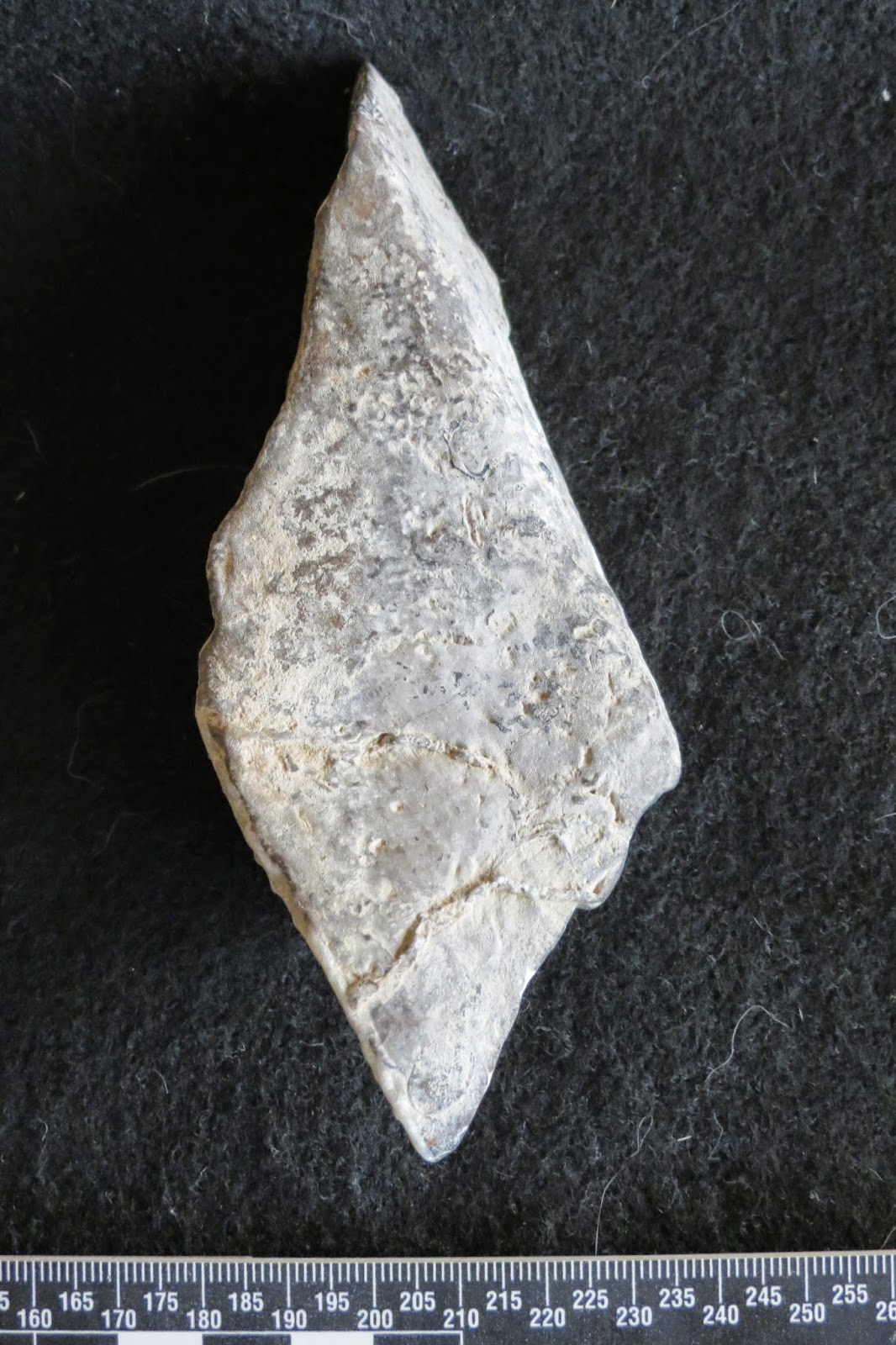
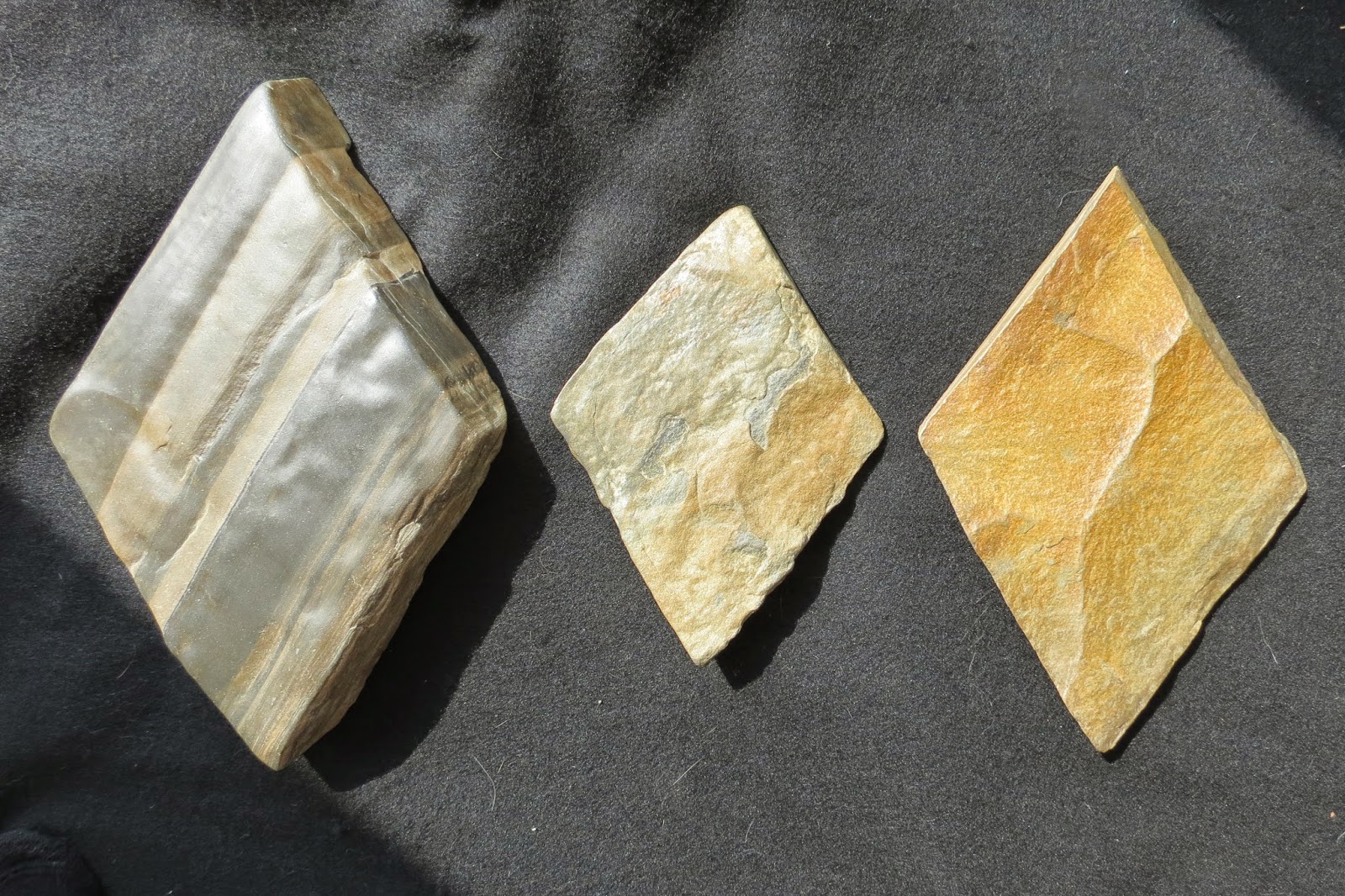
Giant diamond-shaped plaques from the Arkfeld site in Virginia demonstrate likelihood of symbolic significance of some of the similarly shaped stones recognized by many amateur archaeologists

Arkfeld site, #44FK732, Clear Brook, Virginia

Giant diamond-shaped plaques found by Adam Arkfeld in a context of other portable rock art objects and tools. They have no apparent tool function or wear and are strikingly beautiful. They appear to be artifacts of deliberate manufacture. They were aggregated by human activity (curation of the objects) as they were likely imbued with a cultural significance. The stone material is available and was likely quarried and shaped at the Arkfeld site.

 Arkfeld giant diamond-shaped plaque 1

 Arkfeld giant diamond-shaped plaque 2

 Arkfeld giant diamond-shaped plaque 3

Arkfeld site diamond shaped artifact is similar to ones described earlier on this blog as illustrated below. Some of these objects have a similarity to the German-described tool artifact called Faustkeilblatt from the Micoquian tool tradition of the final Acheulean. There may be a continuum of affinity/significance for the diamond form which passes through tool and art morphologies.


Arkfeld site diamond form artifact may be both symbolic and functional

Smaller, rougher, versions like this occur in large numbers at Arkfeld  

Vicki Smith finds, northern Alabama, near the Tennessee River 

more Vicki Smith diamond artifact collection, Alabama side near the Tennessee River

Licking County, Ohio, 18 May 2014 finds

(Top right) The diamond-shaped stone was made on a tabular stone blank using a double-buffer technique where the stone is sandwiched in a vise and edges are broken along the line of tension. These are very common at a suspected Paleolithic site at a spring in eastern Licking County. I set out today with Lyn to find some more and there were too many to count due to recent heavy rainfall. This one is featured because it was found eroding from a hillside within several feet of the three unifacial flint tools (left side) and a utilized red ocher crayon (lower right).

Licking County, Ohio, diamond-shaped artifact associated with a tools and art site


Nadia Clark collection, Prescott, Arizona, found concentrated in the context of figurative portable rock art objects on her property. 


From originsnet.org Photo © A. Wouters. In Wouters, A., Franssen, C, and Kessels. A. (1981). Typologie van de artefacten van de Chopper-Choppingtool Complexen. Archaeologische Berichten 10:18-117. Stichtung Archaeologische Berichten, Elst, NL. Ede II discovered and collected M. Franssen.


"Most of the stones had no particular apparent function. They were mostly at the size to conveniently fit into a person's hand and the majority of them were diamond-shaped. Some of them were obviously created to be in the diamond shape on purpose because you would find such features as the one with the stripe down the middle at left. Sandra suggested they might be female symbols and indicating the female genitals. She also said some of the diamond shaped stones had "orifices" indicated on them."

14 May 2014

Adam Arkfeld compares Virginia mammoth sculpture to Avdeevo, Russia, example

Adam Arkfeld find, identified as a mammoth sculpture, found in immediate context of other stones with mammoth imagery, Arkfeld archaeological site, #44FK732, Clear Brook, Virginia

Ken Johnston interpretation of feline head incorporated into the posterior of the mammoth. This may be seen as analogous to the lion sculpture from the Kostenki  I site in Russia pictured below but in opposite orientation with the mammoth facing left and lion facing right 

Kostenki I lion head facing left combined with mammoth facing right

From spiritboat, "In light of the analysis of Herva and Ikäheimo, compare the following two carved figurines, below, from the Ukrainian refuge. (They are from Kostenki 1 site in Russia, representing the Kostenki-Avdeevo Culture, an upper Palaeolithic culture that is dated between 26,000 and 12,500 years before the present.)"

Sculpture at right is a mammoth outline depicted facing right with a lion head incorporated into its posterior like the Virginia example.

"The figurines are a mammoth and a feline, both of sandstone with red ochre. The mammoth sculpture on the left is not elaborate in its detail.  Herva and Ikäheimo say, “Artefacts that play a marginal role in social interaction may be less elaborated than those contributing to the formation of self-image.”  This might mean the carving was for “situated” uses other than ritual ones, for example, as a children’s toy.  On the other hand, owing to the amount of detailed working, we might hazard the guess that the feline on the right is likely to have been executed as a ritual object."

Adam Arkfeld compares this mammoth figure from his site to one from Avdeevo, Russia, seen here in Mammoths: Giants of the Ice Age by Lister and Bahn.

Portable rock art mammoth head and trunk depiction, found by Adam Arkfeld in immediate context of the mammoth and lion head sculpture featured here.

12 May 2014

A "Feline in Lordosis" sculpture from the Spout Run archaeological site in Bluemont, Virginia

Feline in Lordosis sculpture at Spout Run

From the Spout Run archaeological site, Bluemont, Virginia.  

The cat is in silhouette facing left here. It may be encrusted with remnants of a red ochre based pigment.

I found the "Feline in Lordosis" sculpture within about 10 minutes at the Spout Run site. Like the nearby Arkfeld site, this place will likely produce even many more examples of portable rock art in the future. The photos here suggest a rabbit likeness to some who have viewed them. Because of the age and weathering of the artifacts and our lack of all the cultural background including visual cues of the past, exact interpretations of animals are often difficult. Based on my experience, I believe the sculpture was made based on familiarity with, and significance given to, the mating behaviors of felines.
.
American house cat in feline lordosis position

Pigmented Feline in Lordosis, side 2, facing right. The cat's posterior is depicted as raised at the left end of the figure here, ears folded down and leg forward in a display to indicate readiness to copulate. The figure is about 14cm long.

Chris and René White discovered the Spout Run site on their property. Here, Chris shows a stone bear figure he has identified. Having taken bear himself from the property, he is personally very familiar with their appearance and imagery. (photo from the Winchester Star)

Bear and bear head figures identified by Chris

A flaked anthropomorphic face mask figure identified by Chris. I think it is possible the crested dome of a mammoth head is incorporated into the forehead of the human in this "tall face" depiction. This "shared human forehead with mammoth" is seen in other examples on this blog.

René and Chris White survey part of the concentric circles stone works identified at the Spout Run site. A piece of burned jasper from the site was dated at 10,470 years before present so it provides some limited contextual information supporting a Paleolithic human presence at the site location. (photo from the Winchester Star)

Stone likeness of a mammoth identified by Chris White at Spout Run. The mammoth figure has six vertical marks on its side which could be human made. There are three on the front half of the animal and three on the back half. Other possible mammoth figures have been identified and will be featured on this blog in the future.

.
Spout Run, a tributary creek of the Shenandoah River, flows through Chris and Rene's property and the stone works and portable rock art finds are located just adjacent.

Spout Run archaeological site is about 17 miles as the crow flies from the Arkfeld farm archaeological site featured recently on this blog. The respective site owners are working together to document suspected tools and portable rock art objects and have already noticed significant similarities in lithic materials from the sites.

10 May 2014

Colorado petrified wood artifact with "tally marks" likely a mammoth silhouette figure

Chris Schram collection, Westminster Colorado, interpreted as a mammoth figure

This artifact has about 10 "tally marks" or parallel groove markings across its side. The stroke marks may indicate more meaning given to this object than its possible function as a scraper tool or the like.  The stroke marks are comparable to the marks seen on the mammoth tusk carving of two reindeer at bottom. The marks help confirm the interpretation of a mammoth figure here.

Chris found this piece in the context of many other animal and people figures featured on this blog. It invokes the proboscidean form seen in some Siberian art pieces.


The lead reindeer in this two animal carving on a mammoth tusk has about 10 stroke marks visible across its back. 13,000 years old approximately; Montastruc, France, © The Trustees of the British Museum

The France carved reindeer sculpture and the Colorado mammoth figure may be exhibiting a symbolic marking scheme which was made in a broad tradition which spanned from North America into Western Europe.

08 May 2014

Southern Ohio cupule stone find confirms earlier interpretations of mammoth form symbolism in some of these artifacts

Anonymous mushroom hunter's Springtime find in Pike County, Ohio, is a "cupule stone" where the outline of the stone is an abstracted geometric representation of a mammoth facing left and a simple zoomorphic face profile is depicted on the mammoth's posterior facing in the opposite direction

Simply geometry of the silhouette of the mammoth reconstruction seen here may also be seen in the abstracted shape of the Pike County, Ohio, cupule stone

Manufacture of cupules has been ethnographically documented in Australia as a component of "increase rituals." If the North American cupule is related to the Australian tradition, this kind of sculpture may be seen as meaning something like "more mammoth please." If these hemispheric cupules are a result of antler billet tool dressing as Scot Stoneking has hypothesized, it may reflect the sacredness of the preparation of meta tools- or tools to make other tools, for a mammoth kill, including the flint knapping billet.

Two cupule stones from the Buckeye Lake area, Licking County, Ohio (left), and Perry County, Ohio (right), have been featured earlier on this blog as examples of mammoth iconography. The Pike County cupule stone featured here is especially like the example seen at above right in its representation of the mammoth silhouette. 

A subtle facial profile of a possible feline looking right is highlighted by the markings on this photo. White is eye mark, black is nose mark and red is the mouth of the feline. These features are made by light modification to the stone by chipping and grinding but they are there in accordance with other described examples.

The presence of a zoomorphic face in this posterior of the mammoth position, even though crude and faint, helps confirm this known element of mammoth depiction motifs as seen in other portable rock art pieces. You may use this illustration to help identify this interpreted face on the unmarked photo at (top). The feline presence here on the mammoth posterior may reflect its position as a "helper" in creating access to mammoth as a food resource in the form of carrion.

Scot Stoneking of Massilon, Ohio, has written a book on the cupstone and has replicated through experimentation how many of them were likely created. An article he wrote on the subject was published in Ohio Archaeologist and is also available in .pdf format for download.


Adams County, Ohio, cupule stone exhibiting the mammoth profile form. This object has a flat base on which the sculpture would stand in the mammoth profile position. The base is visible in the lower right quadrant of the photo and is like the base which enables the Buckeye Lake, Perry County, mammoth cupule stone to stand upright.

There is archaeological precedence for cupules on zoomorphic forms.  "Altar from house No. 45, Lepenski Vir Ib, Serbia, carved in the likeness of a fish, possibly a carp." -Don's Maps  Maybe this stone expresses the idea "More fish please."

01 May 2014

Flint bear head figure manufactured around a quartz crystal lined cavity serving as its back lighted "hexagon eye"

Ken Johnston find, Flint Ridge, Ohio, identified as a bear head figure worked around a quartz crystal inclusion and worked to manufacture a back lighted translucent "eye"

Vanport chert bear head figure, Flint Ridge, Licking County, Ohio

Bear head figure translucence demonstrated by my desk lamp.

There is a defined-by-the-artist hexagon shaped area around the eye opening with cortex removal to allow light passage to the front of the stone. The hexagon shape is likely symbolic for the Stone Age artist. It is very well defined and almost perfect in its proportions. (click photos to expand and toggle for comparisons)

The translucent "eye of the bear" in sunlight. The natural crystal-lined cavity penetrates the stone to a depth of 2cm.

Side 2. There is deliberate work to expose the translucence on this side of the stone.

Side 2. Yellow line defines area which transmits light to the back of the stone. Black area has been excavated to depth of 7mm in order to get to the desired translucence. Circle-in-circle is end of eye cavity 2cm deep from other side. This stone figure may be considered a "lithophane," a term I borrowed to describe "portable rock art designed to make light appear" by exploiting transparent or translucent stone features.

Bear head figure at left with scale, (right) a large blade from several meters away, typical of tool artifacts in large numbers at Flint Ridge.


30 April 2014

Sleeping duck sculpture with an eye and feather detail from Jeff Vincent, Mammoth Springs, Arkansas

Jeff Vincent find, Mammoth Springs, Arkansas

This is a sleeping duck sculpture in this art motif already described on this blog. Found in a context of dozens of bird figures and sculptures in Jeff's locale, including as seen in the prior posting. The sleeping duck sculpture is photographed sitting on a large rock here. The duck has an eye and there is work to depict the feathering structure as seen on a real duck below. (click photo to expand)

 Sleeping duck