
A "beaked" uniface. Pam Douglass find, Jacksontown, Ohio
(please excuse the slightly blurred photos)
A beaked uniface. This type of beak is quite common on artifacts in the Licking Valley in Central Ohio, giving them the look of a bird form. The bird forms often have a concave back and a convex breast below the beak. More examples to be posted in the future. It may be diagnostic of a tool type, and/or it could be a way to express bird imagery. The beaks do not appear to have been used so their existence may be wholly symbolic. The other edges often appear to have been lightly used. Also, other types of bird iconography may be found in the area of Flint Ridge, Licking County, Ohio.

with scale included in photo

Another beaked artifact has two, conjoined, egg-like cups.
It may be interpreted as a micro-sculpture of a pregnant woman's torso with legs spread in birthing position.
It may be interpreted as a micro-sculpture of a pregnant woman's torso with legs spread in birthing position.
Pam Douglass finds, Jacksontown, Licking County, Ohio
This beak itself does not have any indication of use as a tool.
 Micro-sculpture of pregnant woman's torso
top yellow line = truncation of the head
bottom yellow line= truncation of the right leg
yellow arrow= woman's vulvar zone, source of human life
white arrow= left thigh. Left leg truncated below yellow arrow.
grey line= bottom of belly of woman
white line= contours in the flint define top of pubic area
green arrow= pregnant and protruding belly of woman

Close up of the woman's torso sculpture representation of the vulvar area
The artist has exploited a naturally advantageous inclusion in the flint to represent the source-issuer of all human life.

The white stone feature with sparkling silver center which represents the vulvar zone on the other side of the artifact penetrates and narrows in the flint so it is seen on this side as a circle and dot (inside white circle markup in the photo above) as opposed to an oval with line on the "feminine side." The blade edge on the left in the photo appears to have been used. The suspected use-wear zone is inside a white bracket markup in the above photo. (click photo to expand)

The cups appear breast-like at this angle. The bird is associated with maternity and providing for the young in Paleolithic art and this may be an intentional symbolic creation of the of the birthing (eggs) and nurturing (breasts) mother motifs. The cups are concave on the artifact but if one looks at the cups as breasts, the breasts appear as if they are convex or protruding from the stone which is in fact an optical illusion. Pictured with scale (mm) on photo right border. The beak is highlighted in white lines here because it visually washed out into the background of the photo.
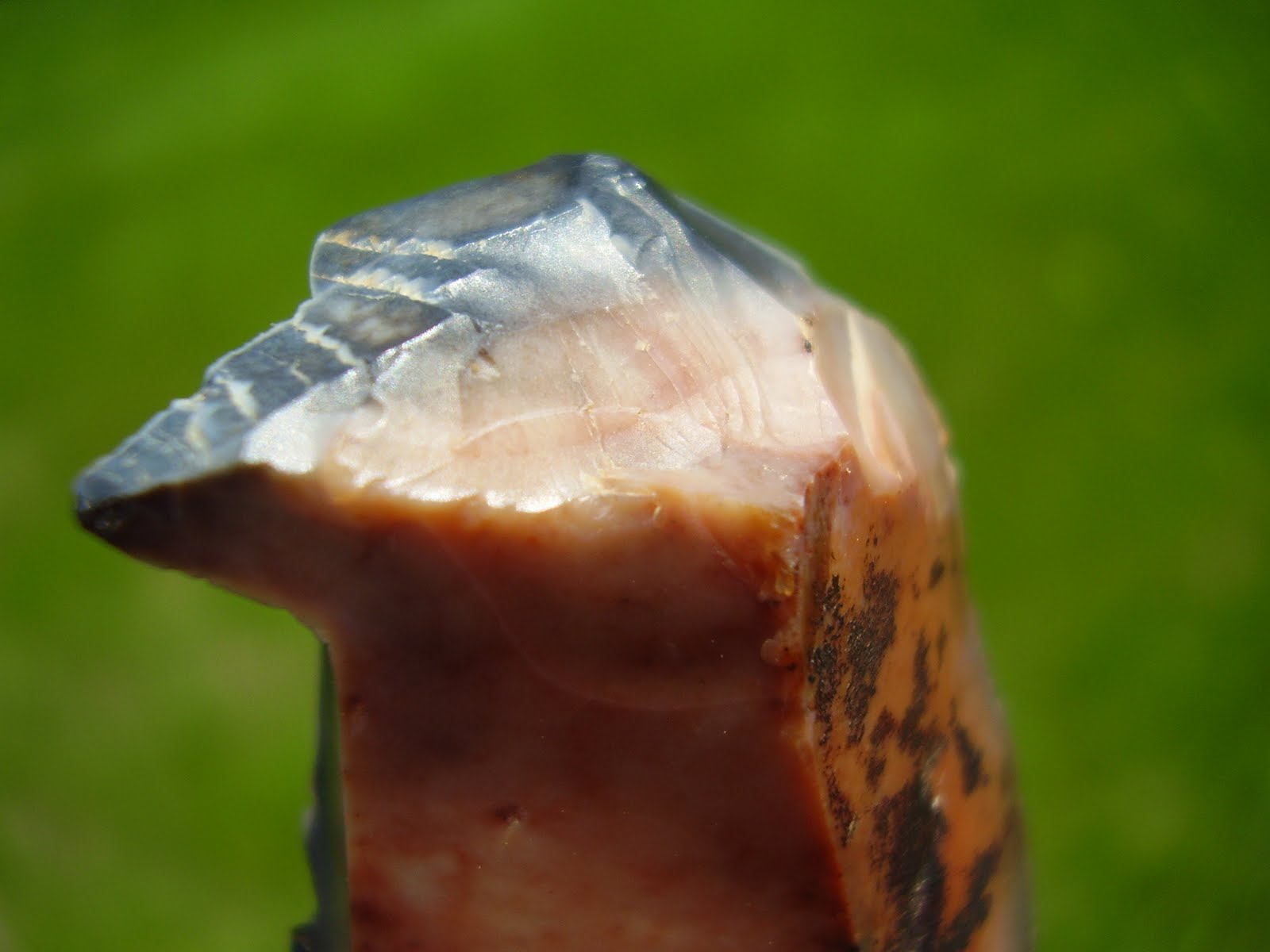
Close up of beaked "bird head" with flint work details.
(click photo to expand view)
This piece may be interpreted as a unified male and female bird where the female side is represented in darker flint, with eggs. The male side is the pink flint, symbolic of female birds often being drab colored compared to their male counterparts.
The artifact and symbolism here are similar to finds at Boukoul, Netherlands, of archaeologist Jan van Es. Please see links at bottom of the portablerockart.com page for Jan van Es' web site. Mr. van Es has described the egg, the bird and the pregnant woman as related icons in Pleistocene portable rock art motifs of Europe. One of the eggs in the nest here is also the woman's belly and the other is her ovate thigh.


