Denisovan Ancestry in East Eurasian and Native American Populations

23 April 2015

One stone from the Bokoul, Netherlands, site and his story

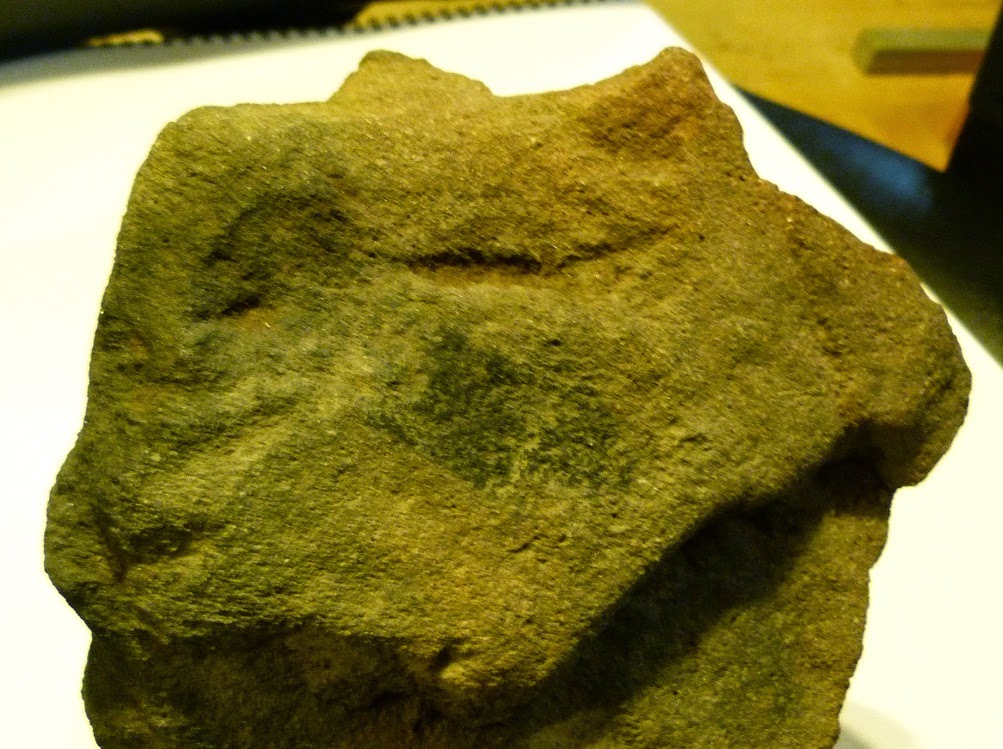
"Two Faces" view, Jan van Es find, Bokoul, Netherlands

In the "two faces" view here, they share an eye in the middle but have separate noses and mouths. The left eye of one face is the right eye of the other face.

Jan van Es writes: "One stone from the Boukoul site and his story. The stone is jasper and working in the old Acheul. 450.000-750.000 lower paleo. The stone (a polymorph) is under 3cm."


All images above are on one stone from the Boukoul, Netherlands, site worked by Jan van Es of Roermond.

20 April 2015

"Rabbit and shout" combination figure from Missouri site is a second example to be considered alongside earlier Tennessee rabbit+shout interpretation

Stacy Dodd and Rod Weber find, The Old Route 66 Zoo Site, 23JP1222, near Joplin, Missouri

Ken Johnston illustration of the combined shout and rabbit forms. The rabbit is depicted as standing upright. There are two incised cuts in the stone to create a clear demarcation between the shout and rabbit sides of the sculpture. There may be some red ocher staining visible near this line.

The two shout+rabbit figures were found about 675 miles apart near Joplin, Missouri, and near Johnson City, Tennessee

"Shout and rabbit head with ears folded back" interpretation made of a Tennessee figure stone in a November 1, 2014 posting on this blog

It is proposed here the combination of the rabbit and the shout PAC-MAN like images had a special cultural meaning to some Stone Age North Americans.

19 April 2015

Pietro Gaietto describes the very early origin of what have been called PAC-MAN like anthropomorphic sculptures as "The shout of Homo erectus"

"The Man of the Romandato" find by Paleolithic art author Pietro Gaietto 

Gaietto writes: "Fig. 4.9) Lithic Sculpture. It represents the head of a hominid with great opened wide mouth.
Size: Height cm. 23.5, width cm. 29, width cm. 18.5. The mouth is wide cm. 17 in the inside and cm. 7 in the tip of the jaw, and is deep cm. 11. Obtained from a large nodule of silex. Weight kg. 11.5.
Place of originrigin: Torrent Romandato, Rodi Garganico, Foggia, Italy.
Material culture: Acheulean or middle Clactonian, or perhaps more recent.
The sculpture has been obtained from a nodule of silex, in which the cavity that constitutes the open mouth is part of the shape original of the nodule.
The strong expression has been interpreted in the typology like " scream ". The stylistic deformation is based, exactly, on the scream.
A study on this sculpture and others two similar, by Pietro Gaietto, (Fig. 4.7 and 4.10) entitled " The shout of Homo erectus " is published on " Paleolithic Art Magazine ",(2000).

Collection Museum of the Origins of Man.

 "The man of Spinacchi" find by Pietro Gaietto


Texas ranch owner becomes yet another United States site reporting PAC-MAN like stone figures in portable rock art contexts

Last week I received a note from a Texas ranch owner which included the following. I added the emphasis in bold type.
"There is a huge limestone rock approx 75 lb with a big centipede fossil stretching across the entire rock. Near that rock are massive metates weighing over 200 lb. I found a Metate/mortar weighing approx 30 lb that had a lot of wear and in the middle of the bowl are two perfectly drilled holes about 4 inches apart that go all the way thru the rock. I'm guessing it's for drainage which is interesting as I've never seen a Metate with holes. Near that Metate I found a large piece or nodular flint with the bottom being completely flat to where it can stand up perfectly. After examining the rock I noticed that it was one large owl statue with a lot of smaller owl faces that look almost subliminal. Every single rock I pick up in this area, no matter if it's limestone, flint or quartz, has some kind of art on it. Every single one. Mostly owls, buffaloes and weird faces.
You're going to think this is weird but I have found a couple of these faces that look exactly like pac-man. It's the damnedest thing I've ever seen.
I think this was a worship or ceremony site as it's unlike anything I've ever seen. I think it's possible they were worshiping that centipede fossil. Anyways, I just want to thank you because I thought I was losing my mind until I ran across your site. There's not much online that covers this subject except for you. Just wanted to say thanks and see if you might have any insight or if you've ever heard of anything like this?" -Texas ranch owner

12 April 2015

Chert "right eye open, left eye missing" human face including worked nostrils and mouth from Mammoth Spring, Arkansas

Jeff Vincent find, Mammoth Spring, Arkansas

Chert "right eye open, left eye missing" face including worked nostrils and mouth from a strong portable rock art context developed by Jeff at Mammoth Spring, Arkansas. Jeff Vincent collection contributing many images for presentation on this blog.

Ken Johnston illustration of the interpreted one-eyed face and a secondary face image nested in the main face, where the nostrils become the eyes of the smaller face. Refer to the unmarked photo to see the two faces at the same time. Click photos to expand.

The "face withing a face" concept may be considered a type of fractal art. It is expressed here by a 9 year old. It is seen in many examples of portable rock art.

Jeff Vincent collection, Mammoth Spring, Arkansas

10 April 2015

Bear figure from The Old Route 66 Zoo Site, 23JP1222, near Joplin, Missouri

Interpreted as a bear figure with its nose sniffing the air. Stacy Dodd and Rod Weber find, near Joplin, Missouri


Side 2 looks like it could depict a running bear or a bird+bear combination appearing like a flying bear

Bear figures from Arkfeld Site, 44FK732, Clear Brook, Virginia

Adam Arkfeld identified a bear-like figure on the back of the same sculpture combining a face mask with a mammoth head featured three postings ago.

Arkfeld site bear figure with nose

Arkfeld site bear figure featured already on this blog

09 April 2015

From Île d'Oléron, France, a right eye open human head sculpture and a possible mother with child figurine

Henri Valentie find, ÃŽle d'Oléron, France

Mr. Valentie writes: "This left profile 3/4 flint I found on the new site on the island of Oleron with many unifacial tools. We can see eye open and the closed eye, nose and the mouth. 15 / 13 / 9.5cm"

Ken Johnston interpretation of another possible animal head figure joined at the nape of the neck to the human and facing in the opposite direction, Janus-like. An eye, nostril and mouth with a tooth suggest this possible zoomorphic form is intended and related to the human face depiction.

Right and left: "Another stone face the mother and child? I apologize but the picture is not great. Limestone 12 / 6.5 / 6 cm" At center is a mother with child figure identified by Jan van Es of the Netherlands for comparison. Click photos to expand.

08 April 2015

Swiss Alps Neanderthal head profile combined with Sapiens head profiles includes feline image

Found by Moray Mackintosh in the Swiss Alps and recognized to depict several faces

Mr. Mackintosh sent the photos to the Paleolithic proto-sculpture and sculpture author Pietro Gaietto who is familiar with portable rock art of the Italian and Swiss Alps. Mr. Gaietto writes:
Dear Mr. Mackintosh,
I reply to letters of 12/2 and 02/27/2015.
The photos you sent me are all interesting, some depicting the head of Homo sapiens neanderthalensis and others are intermediate with Homo sapiens sapiens (intersections ), so it is likely to have an age between the 50,000 and 30,000 years. Certainly should be seen better, but I do not have time for unavoidable reasons.
The place where you found it is good, they have a process clearly visible. Should see the proportion of height of the place and if there are caves in Switzerland with finds of cave bear skulls, collected by Neanderthals as hunting trophies or religious . .
kind regards
Pietro Gaietto 

Ken Johnston illustrated interpretation of two human head profiles joined at the neck and looking away from each other Janus-like

Homo neanderthalensis facial profile looking left with carved lines occupying the back part of the head

Illustration of eye and mouth of stereotypical Neanderthal portable rock art profile including a recessive chin.

Interpreted independently by Ken Johnston and Moray Mackintosh as a feline head representation

Illustration of the faded but present feline head image

The feline head is the top part of the anthropomorphic head depiction here. The flater facial features and solid chin indicate a Homo sapiens sapiens representation.

Mr. Mackintosh interpreted this as a depiction of a human with a feline mask on the top of his head perhaps preparing to lower it.

I interpret this as symbolic of the lion taking a bite out of the human head, a Paleolithic art motif seen in several examples on this blog.

03 April 2015

Human head stone sculpture including a mammoth visage along with tools from the Ice Age Arkfeld site, #44FK732

Human head stone sculpture recovered by Adam Arkfeld, Clear Brook, Virginia.

The sculpture includes a mammoth head facing left in the overall shape of the stone. The upper left of the rock is the "bump" of the mammoth head.

Arkfeld writes: "Interesting features; mouth is another example of fossil utilization. A worm tube has been utilized. Left eye slit is a natural fissure. Right eye slit has been etched into the stone by hand. Its angle matches the left."


Typical Arkfeld site tools along with all the art objects indicate the site may be of great antiquity. However, the archaeology establishment has been unable to comprehend the significance of the finds being made there.

A bias toward flaked tools as the primary indicator of human activity and an ignorance of the importance of crude and opportunistic tools and portable rock art in evaluating archaeology sites leads many to err in thinking objects like these are "just rocks."

A Pleistocene archaeology and rock art scholar with most all of his experience in the "Old World" has called the Arkfeld site "The most remarkable pre-Clovis site in the United States." Hopefully this will not be lost on those who profess to be searching for evidence of the earliest Americans.


The face mask is interpreted here as having the embedded visage of a mammoth in left profile where the mammoth's left eye divot is also the right eye of the human. The tip of the mammoth's trunk is also the mouth of the human. This image is found just inside the overall shape of the rock on its upper left side and may seen as a representation of the mammoth's head bump cresting the human's forehead. This is a motif already described on this blog.

From all of the art we can say "the right eye may have been symbolic of a life portal and the left eye symbolic of a death portal." If so, this piece may be saying "the death eye of the mammoth is the life eye of the human." This notion is compatible with Duncan Caldwell's "Prey-Mother" hypothesis. The death of the mammoth may have been seen as important for human survival.

"Drawing: A human-mammoth hybrid from Les Comparelles Caves in France. Traced from a sketch in Jelinek’s Pictorial Encyclopedia of the Evolution of Man (1975)." (c) Copyright 2015 Brad Lepper and/or The Ohio History Connection, All Rights Reserved.

This kind of human/mammoth combination is seen a good number of postings on this blog and may also be seen in examples of parietal art in Europe.